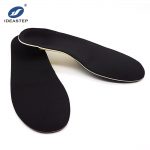
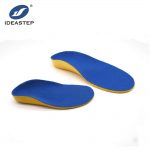
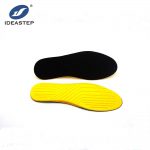
Prefabricated orthotic insoles are widely used in the orthotic, footwear and foot care industries. Produced in standardized sizes and configurations, they offer a practical solution for orthotic laboratories, footwear brands, medical supply distributors and wholesale buyers.
Product performance depends on material selection, structural design and manufacturing quality. For manufacturers, choosing the right combination is essential to achieving consistent specifications, reliable production and competitive costs.
This article outlines the main materials, construction options and manufacturing processes used in prefabricated orthotic insole production.

1. Common Materials for Prefabricated Orthotic Insoles
Different materials provide different levels of cushioning, flexibility and structural support. Manufacturers often combine several materials to meet specific product requirements.
| Material | Main Characteristics | Typical Applications |
|---|---|---|
| EVA | Lightweight, flexible, adjustable hardness | Insole bases, cushioning, arch support |
| PU | Elasticity and cushioning properties | Heel pads, cushioning layers |
| PP | Relatively rigid, thermoformable | Semi-rigid shells, support bases |
| TPU | Flexible, durable, mechanically strong | Support structures, reinforcement |
| Cork | Firm structure, suitable for shaping | Anatomical footbeds |
| Polyester / Nylon | Fabric strength and surface finishing | Insole top covers |
EVA is widely used because of its flexibility, low weight and range of available hardness levels. Density and compression set should be considered when selecting foam for bulk production.
PU is commonly incorporated into heel and forefoot cushioning components, while PP and TPU are suitable for more structured support elements.
Cork and textile materials provide additional options for specialized constructions and product positioning.
2. Common Structural Designs
The overall construction determines how individual materials function together. The following designs are commonly used in prefabricated orthotic insoles.
Single-Layer Construction
Made from one primary material, usually EVA, this design offers straightforward production and fewer assembly steps. It is suitable for basic cushioning and support products.
Multi-Layer Construction
A typical multi-layer insole combines:
- Top cover: Polyester, nylon, microfiber or leather.
- Cushioning layer: EVA, PU or Poron.
- Support layer: EVA, PP or TPU.
- Bottom layer: EVA, rubber or cork.
Different materials can be combined to achieve the required balance of cushioning and structural stability. Bonding strength and thickness consistency are important during assembly.
Semi-Rigid Shell Construction
This design typically combines a PP or TPU shell with EVA or PU cushioning and a fabric top cover.
Shell thickness, arch geometry and heel cup dimensions determine the structural characteristics of the finished product.
3. Manufacturing Processes
The manufacturing method depends on material properties, product geometry and production volume.
| Process | Main Applications | Key Considerations |
|---|---|---|
| Die cutting | EVA, PU and fabric components | Cutting accuracy |
| Laminating | Multi-layer insoles | Bonding strength |
| Compression molding | Molded foam components | Temperature and pressure |
| Thermoforming | PP orthotic shells | Heating and cooling control |
| Injection molding | TPU components | Tooling and production volume |
| 3D printing | Complex TPU structures | Design flexibility and production cost |
For conventional prefabricated orthotic insoles, die cutting, laminating and molding are common production options.
Thermoforming is particularly relevant to PP support shells, while injection molding and 3D printing offer additional possibilities for specialized structural components.
Selecting the right process helps control material usage, production efficiency and dimensional consistency.

4. Quality Control in Production
Consistent quality is essential for manufacturers supplying distributors, footwear brands and orthotic product companies.
Key inspection points include:
- Material specifications: Hardness, density, thickness and surface condition.
- Dimensional accuracy: Length, width, arch profile and heel cup dimensions.
- Bonding quality: Adhesion between fabric, cushioning and support layers.
- Mechanical performance: Compression recovery, repeated flexing and abrasion resistance.
- Batch consistency: Maintaining approved specifications throughout bulk production.
For multi-layer constructions, adhesive compatibility and surface preparation should be controlled to reduce delamination.
Material testing and sample approval should take place before mass production.
5. Key Considerations for Wholesale Buyers
Before starting a prefabricated orthotic insole project, buyers should provide clear technical requirements.
| Requirement | Details to Confirm |
|---|---|
| Product design | Single-layer, multi-layer or semi-rigid |
| Materials | EVA, PU, PP, TPU or fabric |
| Structure | Arch profile, heel cup and thickness |
| Dimensions | Size range and product measurements |
| Branding | Logo, color and packaging |
| Order details | MOQ, samples and lead time |
The intended application should guide material and structural selection. Buyers should also consider tooling costs, production volume and quality requirements when comparing manufacturing options.
A clear specification sheet helps manufacturers evaluate feasibility and provide more accurate quotations.
6. Prefabricated Orthotic Insole Manufacturing at Ideastep
Ideastep, operated by Xiamen KON Technology Co., Ltd., has been involved in foot health and footwear materials since 1989.
We supply orthotic insoles and related foam products to international distributors, orthotic laboratories, footwear manufacturers and private-label brands.
Our manufacturing capabilities include:
- EVA foam cushioning and support constructions.
- PU and multi-layer insole designs.
- PP and TPU support shells.
- Fabric-covered orthotic insoles.
- Molded and semi-rigid orthotic structures.
- OEM and ODM product development.
Material combinations, dimensions, structural designs and branding can be discussed according to project requirements.
Contact Ideastep to discuss your prefabricated orthotic insole project, request a bulk quotation or explore OEM and ODM production options. Samples are available upon request.
Related Post: WG-004 Prefabricated Orthotic Insoles for Running and Training Footwear.