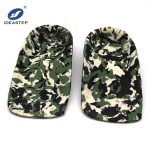
3D Orthotic Insole Lamination Process: Surface Wrapping & Finishing Guide
In 3D orthotic insole manufacturing, surface lamination is a key process that directly affects product comfort, durability, and visual quality. This video demonstrates a real production workflow of applying adhesive surface material onto a pre-shaped 3D insole base.
This process is widely used in OEM and ODM orthotic insole production for footwear brands, medical suppliers, and foot care product distributors.
Watch the 3D insole lamination process below:
1. Preparing the 3D Insole Base and Surface Material
The process starts with a pre-carved and polished 3D orthotic insole base. A roll or sheet of adhesive-backed lamination material is prepared and cut into suitable sections for application.
The backing film is carefully peeled off to activate the adhesive layer, preparing it for surface bonding.
2. Controlled Application on Curved 3D Surface
Unlike flat materials, 3D orthotic insoles have curved geometry, which requires controlled and even application.
The material is gently placed onto the surface without stretching. Because the material has limited elasticity, forceful pulling may cause deformation or uneven bonding.
Instead, the material should be laid down gradually, following the contour of the insole.
3. Pressing and Surface Alignment
Light pressure is applied during lamination to ensure full contact between the material and the insole surface.
The goal is to achieve smooth adhesion without air gaps, wrinkles, or tension stress on the material layer.
4. Trimming and Edge Shaping
After lamination, excess material is trimmed from the edges. At this stage, precision finishing is not required, as a secondary refinement process can be applied later.
Curved scissors or shaped cutting tools are recommended to follow the ergonomic outline of the 3D insole.
5. Edge Refinement and Surface Finishing
If necessary, mechanical grinding or edge smoothing tools can be used to refine the perimeter of the insole.
This step improves both aesthetic quality and wearing comfort by ensuring smooth, non-irritating edges.
6. Final Structure and Functional Stability
After finishing, the surface layer fully integrates with the 3D insole base. The material maintains stability under pressure and does not collapse during walking or long-term use.
This type of self-adhesive lamination is designed for standard footwear applications and ensures reliable performance in daily wear conditions.
Why 3D Lamination Matters in Orthotic Insole Production
For OEM and B2B buyers, surface lamination is not only a cosmetic step—it directly impacts product consistency and performance.
- Ensures stable batch-to-batch quality
- Improves surface durability and wear resistance
- Enhances comfort on curved foot-support structures
- Maintains shape integrity of 3D orthotic designs
Professional lamination processes are essential for high-quality orthotic insole manufacturing.
About Ideastep
Ideastep is a professional manufacturer specializing in 3D orthotic insoles, EVA foam components, and customized foot care solutions.
We provide OEM and ODM services for global footwear brands, medical distributors, and orthotic solution providers, focusing on consistent production quality and scalable manufacturing capacity.