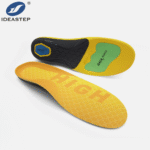
High-arch insoles require a balance between structural stiffness, cushioning, and weight. Their design typically involves a defined arch profile, stable heel structure, and appropriate pressure distribution across the heel and forefoot.
Carbon fiber offers a lightweight reinforcement option for these constructions. Its high stiffness-to-weight ratio makes it suitable for support plates and shells that require structural stability without excessive bulk.
For orthotic brands, footwear manufacturers, and distributors, developing carbon fiber insoles for high arches involves more than selecting a carbon fiber sheet. Plate geometry, laminate thickness, arch contour, cushioning materials, and footwear compatibility all affect the finished construction.

1. Design Requirements for High-Arch Insoles
High-arch constructions require careful coordination between the arch support, heel structure, and forefoot cushioning. A reduced midfoot contact area can increase the importance of support geometry and material distribution.
Key design factors include:
- Arch profile: Define the height, length, and contour according to the product specification.
- Heel stability: Use an appropriately shaped heel cup to establish the rearfoot structure.
- Forefoot cushioning: Select suitable materials and thicknesses for the metatarsal region.
- Structural stiffness: Match the support component’s bending resistance to the intended application.
- Overall thickness: Maintain compatibility with the internal dimensions of the target footwear.
A higher arch profile does not necessarily require a stiffer shell. Excessive rigidity or unsuitable geometry can create localized pressure. Arch contour and material stiffness should therefore be evaluated together.
2. Why Use Carbon Fiber in High-Arch Insoles?
Carbon fiber is valued in technical footwear components for its high stiffness-to-weight ratio. It provides structural reinforcement with relatively low material weight and can be formed into thin support components.
In high-arch insoles, carbon fiber is commonly considered for support plates or shells integrated into multilayer constructions.
Its main characteristics include:
- Low weight: Helps limit the weight added by structural reinforcement.
- High stiffness: Provides resistance to bending and helps maintain the designed profile.
- Thin construction: Can deliver structural reinforcement without a bulky component, depending on laminate design.
- Design flexibility: Fiber orientation, laminate thickness, and component geometry can be adjusted to meet different specifications.
Carbon fiber is not suitable for every insole project. Material cost, stiffness, processing requirements, and bonding compatibility should be assessed against the product’s structural requirements.
3. Carbon Fiber Support and Arch Geometry
Carbon fiber performance depends on both laminate properties and component geometry. Arch height, shell coverage, and edge design determine how the support component integrates with the rest of the insole.
Arch Height and Contour
The arch profile should match the intended product design and footwear dimensions. Increasing arch height alone does not guarantee better support.
Manufacturers should define:
- Arch height and length
- Medial and lateral contour
- Heel-to-arch transition
- Contact surface and edge profile
- Compatibility with cushioning layers
These dimensions should be verified during sample development.
Shell Length and Coverage
Carbon fiber plates can cover different sections of the insole. Some designs extend from the heel toward the forefoot, while others focus on the heel and arch.
Plate length affects bending behavior and the distribution of structural stiffness. The specification should reflect the target footwear and required support characteristics rather than follow a standard length across all products.
Edge Design
Carbon fiber edges require smooth and consistent finishing. Sharp or uneven edges can interfere with surrounding foam layers, surface materials, and adhesive bonding.
The transition between the carbon fiber component and adjacent cushioning layers should be controlled to avoid abrupt changes in thickness or stiffness.
4. Combining Carbon Fiber with Cushioning Materials
Carbon fiber provides structural reinforcement but does not replace cushioning materials. High-arch insoles often combine a rigid or semi-rigid support component with softer layers.
EVA Foam
EVA foam is widely used as a base and cushioning material in orthotic insoles. Different grades offer varying density and hardness characteristics.
In carbon fiber constructions, EVA can support the plate, fill surrounding areas, and create transitions between rigid and softer sections.
Density and hardness should be specified separately. Compression behavior, resilience, and dimensional stability also need to be assessed for bulk production.
PU Foam
PU foam can provide cushioning in multilayer constructions and may be combined with carbon fiber and EVA.
Material selection should consider compression behavior, thickness stability, and bonding compatibility within the finished structure.
Top-Cover Materials
Fabric, mesh, microfiber, and leather are common top-cover options. Selection depends on the product specification, surface requirements, and target footwear.
The top cover should integrate with the underlying layers without adding unnecessary thickness. Adhesive compatibility and resistance to surface separation should be verified on the finished laminate.
5. Lightweight Design and Structural Balance
Carbon fiber can reduce the weight of structural reinforcement, but the total weight of an insole depends on the complete construction.
Relevant factors include:
- Carbon fiber laminate thickness and coverage
- EVA or PU foam density
- Top-cover material
- Adhesive quantity
- Insole dimensions
- Additional reinforcement components
Reducing plate thickness may lower weight but also change bending stiffness. Likewise, using lighter foam does not automatically provide adequate compression resistance.
Manufacturers should compare laminate thicknesses, support geometries, and cushioning combinations as part of the same development process. The finished insole should be assessed for weight, flexibility, structural stability, and footwear fit.
6. Footwear Applications
Carbon fiber high-arch insoles can be developed for different footwear categories, provided that the support structure matches the intended application.
Sports and Athletic Footwear
Sports footwear projects may require low weight, controlled bending behavior, and cushioning. Carbon fiber reinforcement can be considered when a more structured support component is specified.
Plate coverage and stiffness should match the footwear’s flexibility, internal volume, and design requirements.
Casual and Everyday Footwear
Casual footwear designs generally require a balance between support, cushioning, and overall thickness. The carbon fiber component should provide the specified structural characteristics without creating excessive rigidity or reducing available shoe volume.
Orthotic and Specialty Footwear
Orthotic footwear projects may require defined arch profiles, heel cup dimensions, and specific material combinations.
Carbon fiber can be integrated where its stiffness and weight characteristics meet the product requirements. Sample fitting is necessary to verify the relationship between the support structure and the target footwear.

7. Manufacturing and Quality Control
Consistent carbon fiber insole production depends on controlling the laminate, component geometry, and bonding between layers.
Key inspection points include:
- Carbon fiber laminate thickness
- Component dimensions and contour
- Arch height and geometry
- Shell stiffness and bending characteristics
- Edge finishing
- Bonding between carbon fiber and foam layers
- Overall insole thickness and weight
- Surface condition and dimensional consistency
Bonding requires particular attention because carbon fiber and foam have different surface and material characteristics. Adhesive selection and surface preparation should be verified for each material combination.
Quality checks should focus on the finished laminate, not just individual materials. Sample testing can identify delamination, uneven thickness, dimensional changes, and fitting issues before bulk production.
8. OEM and ODM Development Considerations
For brands and distributors developing carbon fiber insoles for high arches, clear technical specifications help reduce sampling adjustments and production inconsistencies.
Before sampling, buyers and manufacturers should confirm:
- Target footwear category
- Arch profile and support geometry
- Carbon fiber type, thickness, and coverage
- EVA or PU cushioning specifications
- Top-cover material and finishing
- Insole dimensions and size range
- Target weight and structural requirements
- Bonding and inspection criteria
Evaluation should focus on the complete construction. A carbon fiber plate may behave differently after integration with foam, adhesives, and surface materials.
Approved samples and documented specifications provide a consistent reference for material sourcing, production, quality inspection, and repeat orders.
Conclusion
Carbon fiber provides a lightweight reinforcement option for high-arch insoles requiring defined support structures and controlled bending characteristics. Its suitability depends on laminate design, arch geometry, shell coverage, and integration with cushioning materials.
For manufacturers, material selection and structural design should be evaluated together. Consistent bonding, dimensional control, and footwear compatibility are equally important to achieving a reliable finished product.
Browse Related Products: https://www.aideastep.com/product/jf-435-2-carbon-fiber-arch-support-insoles/.