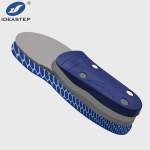
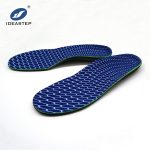
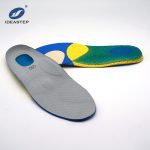
Arch support insoles for high arches require precise support geometry and carefully selected materials. The main design challenge is to accommodate an elevated medial arch while maintaining suitable contact, cushioning and rearfoot stability.
For orthotic manufacturers, footwear brands and wholesale suppliers, product development involves balancing arch height, shell rigidity and cushioning performance. These factors must work together to meet the specifications of different footwear applications.
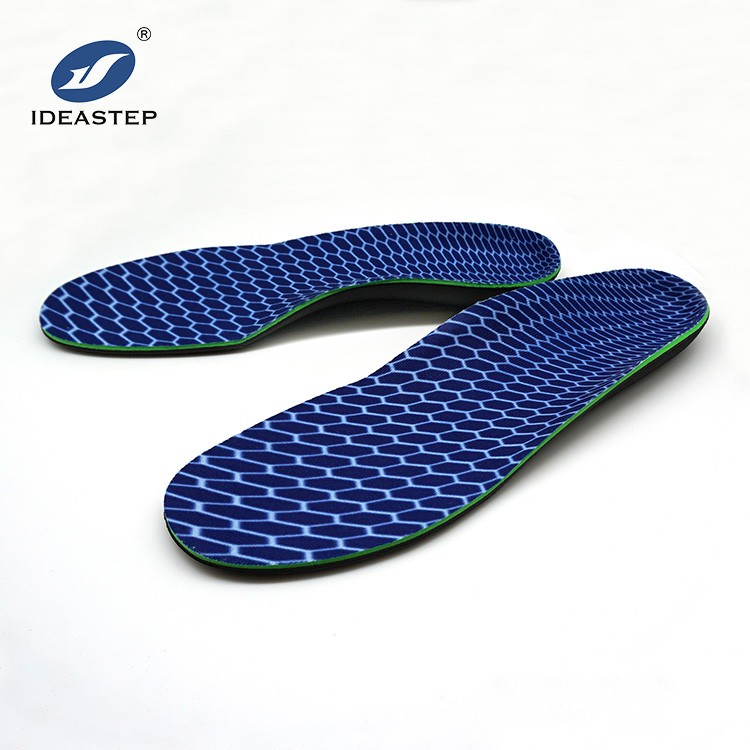
1. Key Design Requirements for High Arch Support Insoles
High arch insole design focuses on three main areas: arch contour, heel stability and forefoot cushioning.
- Arch height and contour: The support profile must match the target foot geometry and provide sufficient contact along the medial arch.
- Heel stability: A structured heel cup helps maintain the intended rearfoot position within the footwear.
- Forefoot cushioning: Suitable cushioning materials help manage pressure in the forefoot area.
- Overall profile: Insole thickness and shape must fit the available footwear space without compromising the support structure.
Arch height alone does not determine support performance. The contact area, shell rigidity and overall geometry are equally important.
2. Materials Used in High Arch Support Insoles
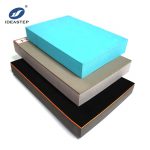
Material selection affects structural support, cushioning, flexibility and product durability. Multi-layer constructions allow manufacturers to combine materials according to specific product requirements.
EVA Foam
EVA is widely used in orthotic insoles because it is lightweight and available in different density and hardness grades.
It can serve as a cushioning layer or part of the main support structure. Material specifications should match the required compression resistance and flexibility.
Polyurethane (PU) Foam
PU foam is commonly used where additional cushioning and shock absorption are required. It can be combined with a structured support shell to balance cushioning and stability.
Thermoplastic Materials
Polypropylene (PP) and TPU are used in semi-rigid and rigid orthotic structures.
PP is suitable for molded support shells requiring structural stability. TPU offers different flexibility characteristics depending on its grade and construction. Material thickness and shell geometry should be matched to the intended support level.
Top Cover Materials
Microfiber, mesh and other technical fabrics are commonly used as top covers. Selection should consider abrasion resistance, thickness, surface quality and bonding compatibility.
3. Structural Design and Customization
The support performance of a high arch insole depends on the interaction between its main structural components.
Medial Arch Contour
The medial arch is the defining support area of this insole category. Its height, length and curvature should be developed according to the target foot profile and product specifications.
For custom projects, foot scans, measurements, technical drawings or approved reference models can be used to establish the required geometry.
Deep Heel Cup
A deep heel cup helps position the heel and provides a more defined rearfoot structure.
Its depth, width and contour should be coordinated with the arch profile to maintain consistent support and fit within the target footwear.
Forefoot Cushioning
EVA, PU and other cushioning materials can be incorporated into the forefoot section. Their density and thickness should be selected according to the product’s cushioning requirements and overall construction.
Shell Rigidity
The support shell controls how the insole responds to loading. PP and TPU can be used to achieve different levels of structural resistance and flexibility.
The required rigidity depends on the intended application, shell thickness and arch geometry. Excessive stiffness or insufficient support can both affect the performance of the finished product.
Multi-Layer Construction
A typical high arch support insole may combine:
- Fabric or microfiber top cover
- EVA or PU cushioning layer
- Semi-rigid or rigid support shell
- Base layer for structural support or bonding
Layer thickness, material compatibility and bonding strength should be evaluated as part of the complete construction.
4. Custom Development for B2B Insole Projects
Custom manufacturing allows brands and orthotic suppliers to define the insole structure according to their product requirements.
Common customization parameters include:
- Arch height, length and contour
- Heel cup depth and geometry
- Support shell material and rigidity
- EVA or PU density and thickness
- Top cover material and color
- Overall dimensions and insole profile
- Logo placement and private-label packaging
Manufacturers can develop samples from technical drawings, physical references or foot scan data. These inputs help establish the product geometry before final sample approval and bulk production.
5. Manufacturing Process and Quality Control
Production consistency depends on accurate processing and control of key dimensions.
Typical manufacturing stages include:
Design and model preparation: Define arch geometry, heel cup dimensions, material specifications and layer structure.
Material preparation: Inspect foam sheets, support shells and top cover materials against approved specifications.
Forming and shaping: Use thermoforming, molding or CNC processing according to the product construction.
Cutting and trimming: Control dimensions, symmetry and edge quality.
Layer bonding: Assemble the top cover, cushioning layer and support shell using compatible bonding methods.
Final inspection: Check arch profile, dimensions, bonding strength, surface quality and overall consistency.
For repeat orders, maintaining consistent arch geometry and material specifications is essential.
6. Sourcing Considerations for High Arch Support Insoles
For orthotic laboratories, footwear brands and wholesale buyers, supplier evaluation should focus on technical capability and production reliability.
Key points include:
- Available arch profiles and support structures
- EVA, PU, PP and TPU material options
- Shell rigidity and cushioning specifications
- Custom sizing and dimensional tolerances
- Top cover and layer construction options
- Sample development and approval procedures
- MOQ, production capacity and lead time
- Quality control for repeat orders
Clear drawings, material specifications and approved samples help reduce development revisions and maintain consistency during bulk production.
Custom Arch Support Insoles for Wholesale and OEM Projects
High arch support insoles require coordinated development of arch geometry, heel structure and material combinations. The final construction should reflect the target footwear application and technical specifications.
Ideastep supports B2B insole development and manufacturing projects, including material selection, structural customization, sample production and bulk supply. Buyers can discuss product requirements and private-label projects with the team.
Related Reading:
Best Insoles for High Arches and Standing All Day
Arch Supports for High Arches: Key Design and Material Considerations