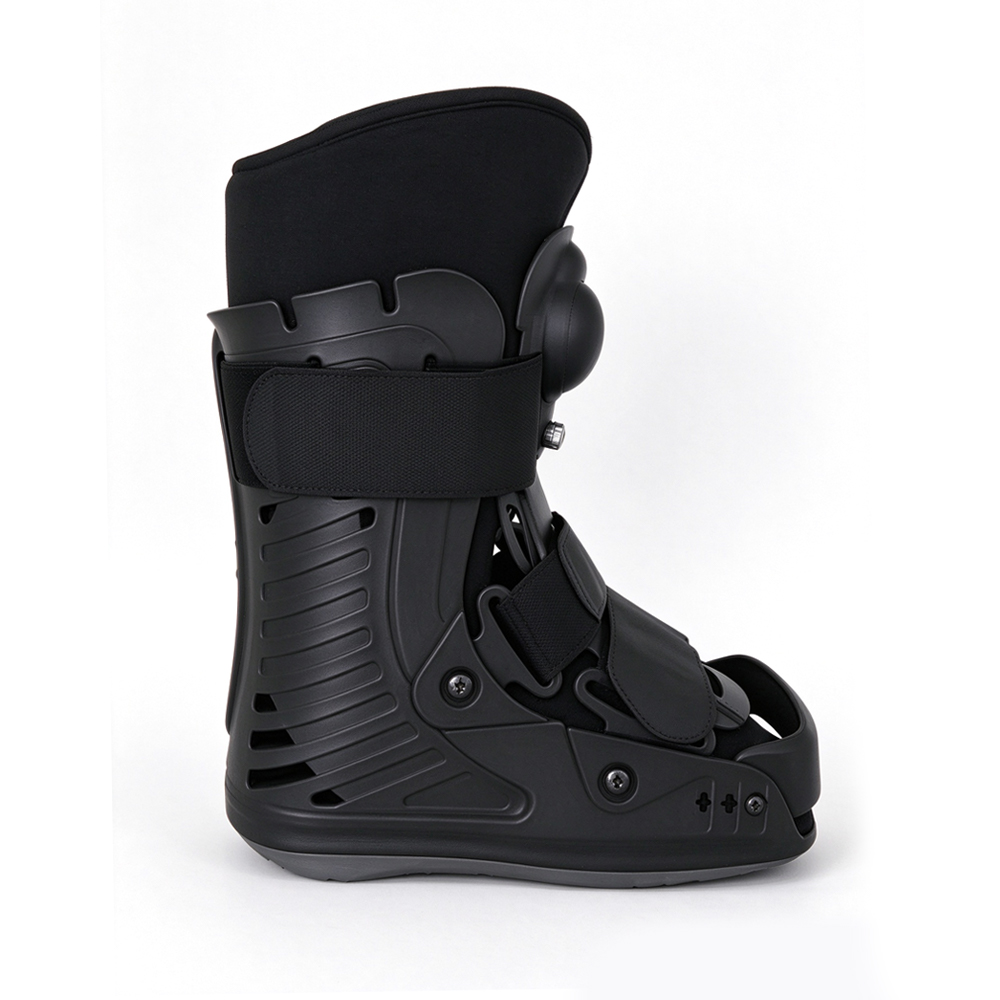
An ankle foot orthosis (AFO) brace is an external support device that extends from the lower leg to the foot. It is designed to stabilize the ankle, control selected movements, and maintain the prescribed foot position.
AFO braces are available in different configurations, materials, and construction styles. For orthotic manufacturers and medical device suppliers, understanding these differences is important when developing product lines, selecting components, and planning production.
Common Types of Ankle Foot Orthosis Braces
AFO braces differ in construction and movement characteristics. The main types include:
Solid Ankle Foot Orthosis
A solid AFO uses a continuous shell around the lower leg and foot. Its rigid construction limits selected ankle movements and provides a stable support structure. Polypropylene is commonly used for this type of brace.
Hinged Ankle Foot Orthosis
A hinged AFO incorporates joints on both sides of the ankle. Depending on the joint design, it can allow movement within specified limits while maintaining support from the surrounding shell.
Posterior Leaf Spring AFO
This design features a narrow, flexible section behind the lower leg and ankle. Its structure allows controlled bending during movement and is generally lighter than a full solid-shell configuration.
Carbon Fiber AFO
Carbon fiber AFOs use composite materials to achieve a lightweight structure with high stiffness. Their design and fabrication requirements differ from conventional thermoplastic braces.
The choice of AFO type depends on the prescribed function, required movement control, and intended construction. These configurations should not be treated as interchangeable products.
Main Components of an AFO Brace
An AFO brace combines several structural and fastening components. Their specifications need to match the selected brace configuration.
1. Upper Shell
The upper shell surrounds the lower leg and provides the main support structure. Its height, shape, and fastening arrangement determine how the brace covers the calf area.
2. Ankle Section
The ankle section connects the upper shell with the foot portion. In solid AFOs, it forms part of the continuous structure. In hinged models, it accommodates the mechanical joint assembly.
3. Footplate
The footplate extends beneath the foot. Its length and shape depend on the brace design and required footwear compatibility.
4. Ankle Joints
Hinged AFOs use mechanical joints to control movement. Joint type, mounting position, and compatibility with the shell must be specified before assembly.
5. Straps and Fastening Systems
Straps help secure the brace around the lower leg and foot. Common configurations use hook-and-loop closures, adjustable straps, or other fastening components.
6. Padding and Liners
Padding and liners are used at selected contact areas to improve the interface between the brace and the lower leg or foot. Material thickness, coverage, and attachment methods should be considered during product development.
Materials Used in Ankle Foot Orthosis Braces
Different AFO constructions require different material properties. The following materials serve distinct purposes in brace manufacturing.
| Material | Key Properties | Common Use |
|---|---|---|
| Polypropylene (PP) | Lightweight, formable, and available in different thicknesses | Thermoplastic AFO shells |
| TPU | Flexible, elastic, and abrasion-resistant | Selected flexible AFO structures |
| Carbon Fiber Composite | High strength-to-weight ratio and stiffness | Lightweight composite AFOs |
| EVA Foam | Lightweight and cushioning | Padding and liner components |
Material selection should account for fabrication requirements, product specifications, and compatibility with other components. EVA foam, for example, is generally used for cushioning rather than as the primary structural shell.
Important Product Specifications for AFO Manufacturing
Clear product specifications help manufacturers maintain consistency across models and production batches.
Before production, the following details should be defined:
- AFO type: Solid, hinged, posterior leaf spring, or carbon fiber construction.
- Size range: Available sizes and corresponding dimensional requirements.
- Shell material: Material type, thickness, and relevant mechanical specifications.
- Joint configuration: Joint type, mounting position, and movement settings where applicable.
- Footplate design: Length, width, shape, and required footwear clearance.
- Fastening system: Strap material, position, quantity, and closure type.
- Padding: Material, thickness, coverage, and attachment method.
- Surface finish: Edge finishing, appearance, and other agreed quality requirements.
For custom orders, drawings, reference samples, and approved specifications should be confirmed before mass production.
AFO Brace Manufacturing and Quality Control
Production methods vary according to the selected construction. Thermoplastic and composite AFOs, for example, require different processing methods.
A typical manufacturing workflow includes:
- Model preparation: Prepare the positive model or digital reference based on the approved dimensions.
- Material processing: Prepare the selected thermoplastic or composite material.
- Brace forming: Shape the material according to the required AFO configuration.
- Trimming and finishing: Complete the shell edges, openings, and attachment areas.
- Component assembly: Install joints, straps, padding, and fastening systems where required.
- Final inspection: Check dimensions, assembly, surface finish, and product consistency.
Quality checks should reflect the product’s specifications. For hinged models, joint installation and alignment require particular attention. For thermoplastic braces, shell dimensions, thickness, and edge finishing are important inspection points.
What Buyers Should Check When Sourcing AFO Braces
For distributors, orthotic laboratories, and medical device manufacturers, product consistency and supplier capability are important when sourcing AFO braces in volume.
Consider the following points before confirming an order:
- Product range: Does the supplier offer the AFO configurations required for your market?
- Customization: Can the supplier work with specific sizes, materials, colors, and component arrangements?
- Sample approval: Can samples be evaluated before bulk production?
- Production consistency: Are specifications and quality standards maintained across batches?
- Order requirements: Confirm MOQ, production lead time, packaging, and shipping terms.
- OEM/ODM capability: Can the supplier support private-label projects and product development?
For repeat orders, maintaining approved samples and documented specifications helps reduce differences between batches.
Custom Ankle Foot Orthosis Brace Supply
AFO braces are not a single standardized product. Their construction, components, and material requirements vary according to the selected design. Clear specifications and reliable production control are therefore essential for manufacturers and distributors sourcing these devices.
Ideastep supports B2B orthotic projects with manufacturing and material solutions. Contact our team to discuss AFO product specifications, custom configurations, sample evaluation, and OEM/ODM supply requirements.
Related Articles:
Knee Ankle Foot Orthotics: Design Features, Materials and Joint Support
Foot Health Awareness: Physical Therapy for the Ankles and Feet