Introduction
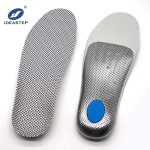
High arch orthotic insoles follow a different design logic from standard supportive inserts, built to address pes cavus and supination patterns. Unlike orthotics for flat feet that lift fallen arches, these models fill the empty midfoot space, stabilise the calcaneus and shift impact away from overloaded heel and forefoot regions. Many wholesale lines cut corners here, simply adding a taller arch bump without calibrated geometry or matching heel containment. This guide covers arch profile tuning, heel cup shaping and layered material design for clinics, podiatry partners and OEM teams building out high arch product portfolios.

Arch Profile Design for High Arch Orthotics
Arch profile controls how load spreads across the midfoot, and height alone does not determine clinical performance. Three core parameters shape the final fit:
- Arch height and contact zone – The profile should follow the natural medial arch contour instead of forcing an aggressive lift. An overly prominent peak creates sharp focal pressure; a shallow profile fails to ease supination. Most clinical options use a gradual, extended contact surface running from the navicular to the base of the metatarsals.
- Arch length and transition – Full-length, three-quarter and arch-only profiles serve separate use cases. Three-quarter styles work well inside tight footwear, while full-length profiles maintain steady alignment through the complete gait cycle. Smooth transitions between arch, heel and forefoot reduce shear during movement.
- Medial and lateral contour balance – High arch feet tend to invert under load. A well-calibrated profile supports the medial arch without restricting lateral movement, preserving natural foot mechanics rather than locking the foot rigidly in place.
For product development, multiple arch height grades are recommended for your catalog. A single “high arch” SKU cannot cover mild, moderate and severe cavus presentations, which leads to fitting complaints from clinic customers.
Heel Cup Geometry and Rearfoot Stabilisation
The heel cup works alongside the arch profile to cradle the calcaneus and anchor the whole orthotic. This feature is frequently overlooked in budget high arch insoles:
- Depth and asymmetric shaping – Deep, contoured cups hold the heel fat pad and limit outward rolling. For feet prone to supination, a slightly raised lateral wall resists inversion better than a symmetric cup. Depth must be balanced against shoe fit; overly deep cups will not fit slim footwear such as dress shoes or running trainers.
- Heel base width – The cup footprint needs to match the target heel width. Narrow cups shift sideways under load, while overwide cups waste space inside the shoe and reduce arch engagement.
- Bevel and exit angle – Soft outer bevels prevent edge irritation. A sharp, unbevelled heel rim creates pressure points, especially for patients with sensitive heels or thin fat padding.
From a clinical perspective, the heel cup’s job is to hold the heel in neutral alignment so the arch profile can function properly. Without reliable rearfoot containment, even a precisely shaped arch will lose effectiveness once the foot rolls outward.
Material Design and Layered Stack Options
High arch insoles need a mix of structural stability and targeted cushioning. Cavus feet tend to concentrate impact at the heel and metatarsal heads, so rigid shells alone rarely deliver acceptable comfort:
- High-density EVA – The most versatile base option. Tunable hardness supports semi-rigid arch geometry, lightweight and easy to trim during clinic fitting. It suits entry and mid-tier wholesale ranges, though compression set testing is necessary to avoid gradual loss of support over time.
- TPU or polypropylene shell reinforcement – Embedded beneath foam layers for firm, consistent arch retention. These rigid cores are selected for prescription-grade lines where reliable biomechanical control is the priority.
- Poron or PU cushioning layers – Added at heel and forefoot for shock attenuation. These high-resilience foams handle repeated impact and cut peak plantar pressure, a key requirement for high arch patients prone to metatarsalgia and heel strain.
- Carbon fiber plates – Reserved for premium, slim-profile designs. Carbon delivers high stiffness at low thickness, ideal for athletic applications and tight footwear where bulk is a constraint.
- Top cover textiles – Antimicrobial, perforated microfibre or mesh reduces moisture buildup and friction. Sealed edges stop layer separation after repeated trimming and wear.
Hybrid stacks are the most common commercial solution: a rigid or semi-rigid support core carries arch load, while softer foam layers cushion high-pressure zones. This balances stability and comfort better than single-material builds.
Clinical Matching and Catalog Positioning
- Mild high arch: Soft to medium density EVA profiles, moderate arch height and shallow-to-medium heel cups, suitable for lifestyle use and general pain relief.
- Moderate cavus and supination: Reinforced TPU shell, extended arch contact zone, asymmetric deep heel cup, paired with Poron forefoot and heel padding.
- Severe cavus or post-surgical cases: Custom-scanned orthotics or carbon fiber reinforced prefabricated units, prescribed under clinician supervision.
Clear product labelling helps your clinic partners pick the right SKU. Avoid marketing all high arch insoles as universal corrective devices.
QC Benchmarks for Wholesale Sourcing
- Check compression set on foam layers to confirm arch height does not degrade under cyclic loading
- Verify heel cup dimensional consistency across production batches
- Test lamination strength between rigid core and cushioning layers to prevent delamination
- Validate edge finishing and check for sharp contours that create pressure points
- Maintain full material traceability and CE documentation for medical distribution
FAQ
Are high arch insoles only for supination?
They are most often prescribed for supination linked to pes cavus, though they also support high arch patients who do not roll outward. The core goal is pressure redistribution, not just controlling gait motion.
Can high arch insoles be heat modified by clinicians?
EVA-based semi-rigid options can be adjusted with chairside heat tools. TPU, polypropylene and carbon fiber reinforced shells hold fixed geometry and cannot be reshaped after manufacturing.
What is the most common complaint from patients using high arch orthotics?
Most issues come from over-aggressive arch height or poorly finished heel cup edges. Patients report sharp midfoot pressure or heel irritation, which can be reduced by refining the arch transition and adding soft beveling.
Do high arch insoles require metatarsal pads?
Not always, but metatarsal padding works well as an add-on for high arch patients with forefoot pain. Many distributors offer it as a modular accessory to expand clinical flexibility.
Which material stack works best for private label bulk orders?
High-density EVA with optional TPU reinforcement is the easiest to scale, sample and validate. Carbon fiber variants carry higher tooling and testing costs, better suited for premium, lower-volume SKUs.
Conclusion
Well-engineered high arch support insoles depend on coordinated design: a gradually shaped arch profile, a stabilising heel cup built for supination mechanics, and layered materials that balance structure with impact cushioning. Products built around nothing more than a raised arch bump often fail clinically, because they ignore rearfoot control and pressure distribution.
We can develop graded arch profiles, hybrid material stacks and custom heel cup geometries for your prefabricated or private label orthotic catalog. Share your target patient segments and footwear fit requirements, and we will map out a high arch product range aligned with your wholesale and clinic partners.
Related Articles: Wholesale High Arch Support Insoles: OEM Custom Solutions for Cobblers & Orthopaedic Workshops.