Introduction: Flat Feet in Long Standing Environments
Flat feet (pes planus) significantly affect lower limb biomechanics, especially in occupations that require prolonged standing. In clinical orthotic practice, this condition is not treated as a simple comfort issue, but as a structural load distribution problem.
When the medial longitudinal arch collapses or remains excessively low, the foot loses its natural shock absorption mechanism. As a result, load is transferred abnormally to the plantar fascia, medial ankle, knee joint, and even the lumbar spine during prolonged standing.
In industrial and healthcare environments, this biomechanical imbalance becomes more pronounced due to continuous static loading on hard surfaces such as concrete or tile flooring.
Clinical Biomechanics: What Happens When Flat Feet Stand All Day
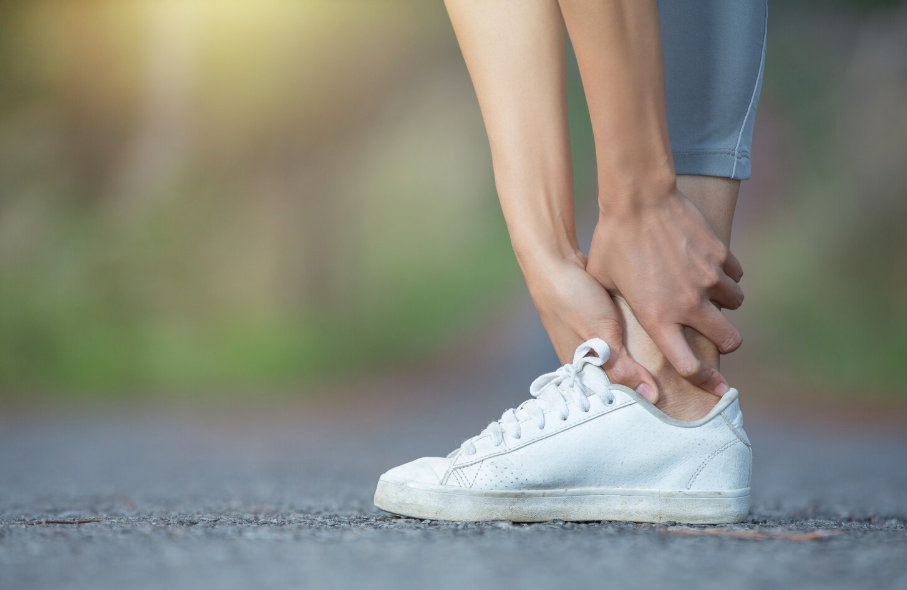
From a biomechanical standpoint, prolonged standing in flat feet leads to persistent overpronation. This means the foot continuously rolls inward during weight-bearing, causing misalignment throughout the kinetic chain.
Common clinical presentations include:
- Medial heel pain due to plantar fascia overload
- Arch fatigue caused by ligament stretching
- Anterior knee discomfort due to tibial rotation
- Lower back fatigue from compensatory posture changes
In most orthotic cases, symptoms worsen progressively when no structural support is applied during long working shifts.
Why Flat Feet Require Medical-Grade Insoles for Standing Work
Flat feet insoles for occupational use must go beyond cushioning. In clinical orthotics, the primary goal is not softness, but controlled alignment support under load.
Soft cushioning-only insoles may temporarily reduce discomfort; however, they do not correct excessive pronation or stabilize the medial arch during long standing cycles.
As a result, structural correction becomes essential in workplace environments where repetitive loading is unavoidable.
Why Soft Insoles Often Fail in Flat Feet Management
In real-world clinical observation, cushioning-only insoles frequently fail in flat feet cases requiring long-term standing support.
Initially, users may experience relief due to surface pressure reduction. However, under continuous load, soft materials such as low-density foam undergo compression set, leading to loss of thickness and support.
Once this occurs, the foot returns to a near-flat condition, resulting in repeated overpronation without correction. This explains why many users report that insoles feel effective only during the first few days or weeks of use.
From a biomechanical perspective, unresolved arch collapse continues to overload the plantar fascia and medial kinetic chain, maintaining symptom progression.
What Makes the Best Insoles for Standing All Day Flat Feet
1. Medial Arch Support Geometry
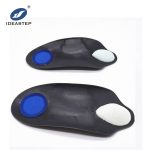
A clinically effective insole must provide controlled medial arch elevation. The goal is not rigid correction, but guided support that reduces excessive pronation under load.
2. Heel Stabilization System
A deep heel cup improves calcaneal alignment and reduces rearfoot instability. This is critical for flat feet, where heel valgus is commonly observed.
3. Shock Absorption for Static Load
Unlike running biomechanics, standing involves continuous micro-loading. A multi-density shock absorption system is required to reduce cumulative plantar stress.
4. Pressure Redistribution Design
A properly engineered insole redistributes plantar pressure away from the medial arch and heel toward a broader contact surface, reducing localized tissue overload.
5. Medical-Grade Multi-Layer Construction
In professional orthotic manufacturing, flat feet insoles for standing work are typically constructed using a layered system:
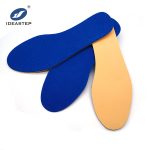
- Top layer: moisture-wicking comfort interface
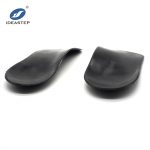
- Mid layer: EVA or PU structural arch support core
- Base layer: high-density reinforcement for stability under continuous load
This architecture ensures both biomechanical control and long-term durability in occupational environments.
Clinical & Occupational Applications by Industry
Healthcare Professionals
Nurses and medical staff experience prolonged standing and rapid directional movement. Insoles must combine shock absorption with stable arch control to reduce cumulative fatigue.
Retail & Service Industry Workers
These users alternate between standing and walking. Moderate arch support with flexible cushioning is typically recommended.
Factory & Warehouse Workers
Long-duration static standing on hard concrete floors requires high-density EVA-based orthotic structures to prevent fatigue accumulation and joint overload.
Office Standing Desk Users
Static posture increases sustained plantar pressure. Heel stability and arch support are more important than cushioning alone in these scenarios.
EVA vs Memory Foam vs PU in Flat Feet Orthotic Design
Material selection is a critical factor in medical-grade insole performance:
- EVA: Provides structured arch support and controlled deformation resistance; widely used in orthotic correction systems
- Memory foam: Enhances comfort perception but lacks long-term structural stability under continuous load
- PU: Offers durability and balanced mechanical response for occupational applications
In clinical orthotic manufacturing, EVA-based hybrid systems are generally preferred for flat feet requiring standing support due to their predictable load behavior.
Clinical Orthotic Insight: Correction vs Cushioning
A fundamental distinction in orthotic treatment is between cushioning and correction. Cushioning reduces surface pressure, while correction influences foot alignment and gait mechanics.
In flat feet cases requiring prolonged standing support, correction plays a more important role than cushioning alone. Without structural guidance, the foot continues to collapse medially under repetitive load.
Therefore, medical-grade insoles prioritize controlled arch geometry rather than soft deformation alone.
How to Select Medical-Grade Insoles for Flat Feet Standing All Day
Selection should be based on biomechanical needs and occupational conditions:
- Arch level: low to moderate corrective support for adaptability
- Heel cup depth: improves rearfoot stabilization
- Material density: prevents early compression failure
- Work environment: concrete floors require higher structural rigidity
- Duration of standing: longer shifts require enhanced fatigue resistance
Orthotic Manufacturing Perspective: Product Classification
In OEM orthotic production systems, flat feet insoles are typically classified into three performance tiers:
- Comfort-grade: memory foam-based products for short-duration wear
- Support-grade: EVA/PU hybrid systems for daily occupational use
- Medical-grade orthotic: structured arch correction systems designed for clinical or long-standing environments
This classification directly influences material selection, pricing structure, and target market positioning in B2B procurement.
When Insoles Should Be Replaced
Even medical-grade insoles have a functional lifespan under occupational use. Replacement is recommended when:
- Arch support shows visible deformation
- Heel stability decreases during standing
- Midfoot collapse reappears
- Fatigue symptoms return despite regular use
Conclusion: Best Clinical Solution for Flat Feet Standing All Day
The best insoles for standing all day flat feet are defined not by softness, but by structural control, load distribution efficiency, and long-term biomechanical stability.
In clinical and occupational orthotic practice, EVA-based multi-layer systems remain the most reliable solution due to their predictable mechanical behavior under continuous load conditions.
We provide OEM and ODM medical-grade orthotic insole solutions for flat feet, including custom arch geometry design, EVA density calibration, and multi-layer structural development for healthcare, industrial, and professional footwear applications. Prototype sampling and bulk production support are available for global B2B partners.
Recommended Reading: Do Orthotic Insoles Really Work for Flat Feet?.