Why EVA Wedge Supports Are Essential for Orthotic Protocols
Pre-fabricated orthotic insoles rarely meet every patient’s biomechanical requirements out of the box. Wedge inserts deliver controlled, incremental alignment adjustments to address rearfoot varus, valgus drift and lower-limb rotational abnormalities. Among common substrate options including cork, PU and rubber, cross-linked EVA has become the preferred clinical and branded accessory material.
Rubber offers high stability but adds weight and resists clean trimming. Cork performs well as a thermoformed base orthotic yet lacks the consistent density grades required for precision stacked posting. Cross-linked EVA balances adjustability, predictable compression set and low material waste. Our EVA wedges serve three core B2B use cases: chair-side practitioner modification, bundled add-ons for finished orthoses, and standalone SKUs for foot care catalogues.
Core Mechanical Advantages of Custom EVA Wedge Inserts
Tunable Shore Hardness for Graduated Correction
We produce EVA wedges across a range of Shore C densities to match correction intensity. Lower-density grades suit mild positional adjustments; firmer stock supports sustained rearfoot control for high-activity or higher-weight users. This graded selection eliminates the risk of over-correction that comes with single-density wedge stock.
Easy Trimming and Sanding for Chair-Side Fitting
Clinicians frequently stack, contour and resize wedges during appointments. Quality cross-linked EVA cuts cleanly with standard orthotic blades and sands without crumbling, supporting lean clinic inventory while accommodating a broad spectrum of gait presentations.
Stable Compression Resistance to Maintain Correction Geometry
Prolonged loading causes low-grade, non-cross-linked EVA to permanently compress, altering the intended posting angle and triggering clinical follow-ups. All our production batches undergo cyclic compression testing to lock in consistent performance and preserve corrective geometry through regular use.
Closed-Cell Structure for Moisture Resistance and Sanitation
Closed-cell EVA repels moisture absorption and resists odour retention. This property suits sports orthotics, work footwear inserts and clinical settings where hygiene control is prioritised, reducing cross-contamination risk and simplifying routine cleaning.
Peelable Medical-Grade Adhesive Option
We supply plain unbonded wedges and variants fitted with low-residue medical adhesive backing. The adhesive secures the wedge to the orthotic base under gait load and remains removable for repositioning during follow-up fitting sessions.
OEM & ODM Wholesale Programme for EVA Orthotic Wedges
Available Customisation Parameters
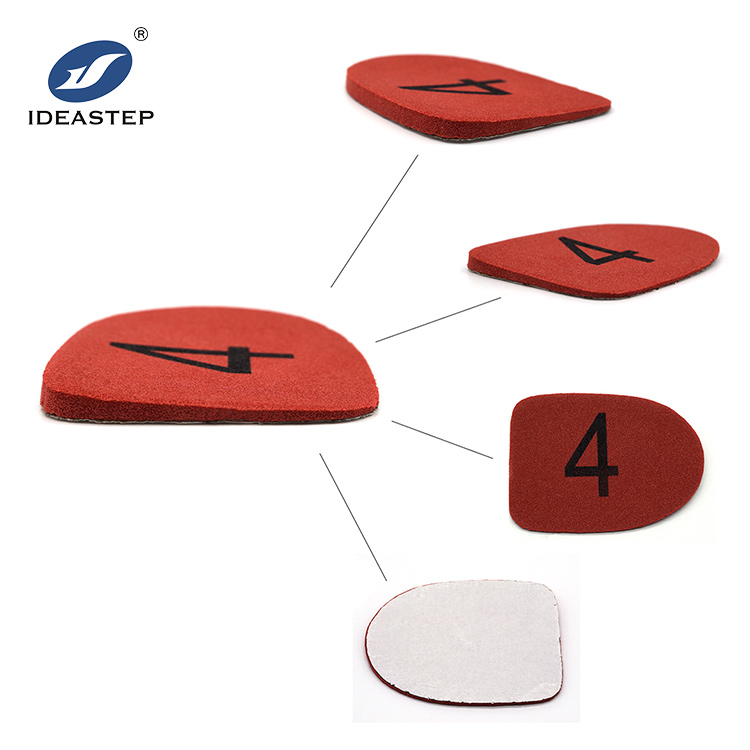
Our engineering team adjusts wedge angle, thickness, footprint, EVA density, adhesive coating and surface finish per specification. Additional customisation includes laser marking, hardness-coded colour sorting, pre-pack size assortments and private-label packaging. Clients may supply custom artwork or select standard bulk packaging templates for faster lead times.
Two Sourcing Paths: Standard Stock and Fully Bespoke Moulded Profiles
Stock wedges cover common 2°, 4°, 6° varus and valgus angles for fast fulfilment and lower entry costs. For proprietary orthotic ranges requiring unique geometry, we accept technical drawings and 3D scan files to develop brand-exclusive tooling.
Sampling, MOQ and Lead Time
Flexible minimums allow clinics and emerging foot care brands to trial wedge assortments without large inventory commitments. The sampling workflow validates angle accuracy, hardness and fit prior to mass production. Fixed timelines are confirmed once specifications and sample sign-off are finalised.
Export Compliance and Technical Documentation
We provide material test certificates and technical data sheets for EU and North American shipments. These wedges are supplied as biomechanical alignment accessories, not certified medical devices unless separately validated under the client’s regional regulatory framework. Documentation supports internal compliance review for clinical channel partners.
Brand Support Assets
We supply spec sheets, technical reference charts and training talking points to help your team educate clinical practitioners on wedge selection and stacking methodology.
Key Clinical and Product Applications
Heel Wedges for Rearfoot Alignment
Medial and lateral heel wedges manage overpronation, supination and calcaneal drift. They reduce tibial rotation and associated strain linked to shin and knee loading patterns.
Metatarsal Wedges for Forefoot Load Redistribution
Anterior wedges offload sensitive metatarsal heads, commonly paired with orthoses for metatarsalgia and transverse arch dysfunction.
Supplementary Posting for Finished Orthotic Insoles
Pre-moulded orthoses offer limited fine-tuning capacity. Stackable EVA wedges enable clinicians to adjust support without replacing the base orthosis, lowering clinic inventory overhead.
Wedge Supports for Sports Rehabilitation
Modular EVA wedges deliver lightweight temporary gait adjustment for athletes progressing through return-to-sport rehabilitation protocols.
Paediatric Orthotic Interventions
Low-profile graded wedges provide conservative, adjustable intervention for flexible paediatric heel misalignment, with modifications possible as foot morphology develops.
Critical Technical Sourcing Criteria
EVA Grade and Cross-Linking Impact on Service Life
Recycled or lightly cross-linked EVA carries a lower unit cost but exhibits rapid compression set. Virgin cross-linked EVA delivers stable long-term correction. We outline this tradeoff during consultation to match material grade with budget and performance targets.
Angular Tolerance Control
Minor deviations from specified wedge angles alter biomechanical outcomes. We maintain tight angular tolerances for clinical SKUs and include batch inspection records with documentation.
Adhesive Formulation Selection
Standard adhesive works for everyday indoor use. We specify upgraded adhesive for high-sweat athletic or elevated-temperature applications to prevent delamination.
Safe Stacking Guidance
Excessive stacked wedges create instability and compromise shoe fit. We advise wholesale partners to maintain tiered single-angle wedge inventories rather than over-reliance on multi-layer builds.
Wholesale Buyer FAQs
Can EVA wedge inserts stack with cork orthotic insoles?
Yes. Many clinics pair EVA posting wedges with cork base orthoses for a stable primary platform plus adjustable secondary correction. Verify total heel height compatibility with the target shoe last.
How to select EVA hardness for different presentations?
Softer densities apply to mild alignment corrections and paediatric cases. Firmer EVA is specified for higher-weight users, chronic overpronation and active rehabilitation. A selection reference chart accompanies every sample pack.
Can wedge orders combine with other orthotic accessory SKUs?
Mixed-SKU shipments are supported. Consolidate EVA wedges, orthotic pads and other foot care components to optimise freight costs.
Is custom wedge geometry protected after tooling fabrication?
All OEM custom moulds remain reserved exclusively for your brand unless written reuse approval is provided.
Request Samples to Launch Your Bespoke EVA Wedge Programme
If you operate a podiatry clinic, footwear brand or foot care distribution business and plan to add custom EVA wedge inserts to your orthotic accessory catalogue, contact our team. Share your target correction angles, hardness mix and packaging requirements. We will arrange sample evaluation and build a wholesale solution aligned with your clinical or product roadmap.
Related Reading:
Beyond Basic Cushioning: Choosing EVA Wedge Pads for Different Footwear Applications
EVA Wedge Pads in Orthotic Design: How Material Choice Affects Product Performance