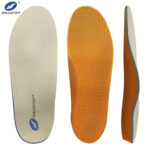
Developing orthotic insoles for the medical supply market requires careful control of materials, product structure, and manufacturing specifications. For brands and distributors, the challenge is to develop products that meet defined requirements while maintaining consistent quality across production batches.
ODM manufacturing provides a practical approach. Instead of managing every stage internally, brands can work with a manufacturer to develop insole structures, select materials, approve samples, and organize bulk production.
Ideastep is the brand of Xiamen KON Technology Co., Ltd. With a footwear materials manufacturing background dating back to 1989, Ideastep provides orthotic insole development and production services for medical supply brands, distributors, and other B2B customers.

1. ODM Orthotic Insole Development
ODM projects begin with the buyer’s product requirements. These may include the intended application, target footwear, support structure, material preferences, size range, and expected order volume.
Based on these specifications, the manufacturer develops a suitable construction and prepares samples for evaluation.
Typical ODM development work includes:
- Developing new insole structures
- Adjusting arch profiles and heel cup geometry
- Selecting cushioning and support materials
- Designing multilayer constructions
- Establishing product dimensions and size ranges
- Preparing samples and production specifications
A clear product brief helps avoid unnecessary revisions. Technical drawings, reference samples, and defined material requirements are useful starting points, particularly for projects involving multiple sizes or product models.
2. Material Selection for Orthotic Insoles
Material selection affects the insole’s thickness, flexibility, weight, cushioning characteristics, and structural stability. The right combination depends on the intended construction rather than a single material preference.
EVA Foam
EVA foam is widely used in orthotic insole manufacturing. Different grades offer varying density and hardness characteristics, making it suitable for base layers and cushioning components.
For ODM projects, density and hardness should be specified separately. Compression behavior, resilience, dimensional stability, and bonding compatibility also need to be considered.
PU Foam
PU foam is another option for cushioning layers. Its physical properties vary by formulation, allowing manufacturers to select grades for different construction requirements.
Evaluation should cover compression behavior, thickness stability, and compatibility with adjacent materials.
TPU and Thermoplastic Support Components
TPU and other thermoplastic materials can be used for heel stabilizers, arch support elements, and semi-rigid shells.
Their thickness, geometry, and stiffness should match the intended product structure. These components also need to be assessed after integration with foam layers, since the finished construction may behave differently from individual materials.
Top-Cover Materials
Common options include mesh, fabric, microfiber, and leather. Selection depends on the product’s surface requirements, target footwear, and intended positioning.
Abrasion resistance, moisture-related properties, adhesive compatibility, and resistance to surface separation should be considered during material evaluation.
3. Product Structure and Design Specifications
The performance and consistency of an orthotic insole depend on how its components work together. Material selection should therefore be coordinated with the structural design.
A multilayer construction may combine a fabric or leather top cover, EVA or PU cushioning, and a TPU or thermoplastic support component. The actual layer arrangement depends on the product requirements.
Several specifications deserve particular attention.
Arch profile: Define arch height, length, and contour according to the intended product design. Material hardness alone cannot determine the required support geometry.
Heel cup: Confirm depth, width, and wall shape to maintain consistency across sizes and product models.
Thickness distribution: Control thickness across the heel, arch, and forefoot. Abrupt transitions can affect construction quality and footwear compatibility.
Size grading: Adjust dimensions and support geometry across the size range. Simply scaling the overall length may not preserve the intended structure.
These details should be documented in product drawings or approved specifications before production.
4. Sample Development and Approval
Sample development allows both parties to verify the construction before bulk manufacturing.
A typical process includes four stages:
- Requirement review: Confirm the application, drawings, reference samples, materials, dimensions, size range, and order quantity.
- Construction proposal: Select suitable materials and define layer arrangement, thickness, support components, and finishing.
- Sample production: Prepare a prototype that reflects the proposed production construction as closely as possible.
- Evaluation and approval: Review dimensions, materials, bonding, surface quality, and footwear compatibility. Record any revisions before final approval.
The approved sample should serve as the production reference. Changes to materials, dimensions, or construction should be documented and confirmed before implementation.
5. Quality Control for ODM Orthotic Insoles
Consistent specifications are essential for medical supply brands, especially when products are manufactured in multiple sizes or reordered over time.
Quality inspection should cover both incoming materials and finished insoles.
| Inspection Area | Key Checks |
|---|---|
| Raw materials | Material type, thickness, density, and hardness |
| Dimensions | Length, width, thickness, and size tolerances |
| Structure | Arch profile, heel cup geometry, and component positioning |
| Bonding | Adhesion between foam, support components, and top covers |
| Surface quality | Wrinkles, contamination, edge finishing, and visible defects |
| Finished product | Overall consistency, weight, and dimensional stability |
| Batch control | Conformity with approved samples and specifications |
Multilayer constructions require particular attention to bonding and material compatibility. Individual layers may meet their specifications but still produce problems when combined.
Where a product requires specific performance or medical claims, the relevant test methods and acceptance criteria should be agreed upon in advance. Material descriptions alone do not establish clinical performance or regulatory compliance.
6. MOQ, Lead Time, and Production Planning
ODM projects should be evaluated from both technical and production perspectives. Material availability, construction complexity, size grading, and order volume can all affect manufacturing schedules.
Before confirming an order, buyers should establish:
- Final product specifications and approved drawings
- Material sourcing requirements
- Size range and grading arrangements
- Minimum order quantity
- Sample approval procedures
- Production and delivery schedules
- Packaging and labeling requirements
- Inspection standards
For reference, Ideastep’s insole MOQ is commonly around 1,000 pairs. Sample development may take approximately seven days, while bulk production often takes around 45 days.
These are general planning references. Actual quantities and lead times depend on material availability, product complexity, and order requirements.
7. ODM Cooperation with Ideastep
Ideastep focuses on orthotic insoles and footwear-related materials for B2B customers. Its manufacturing background dates back to 1989, with experience in footwear materials and insole production.
Available material options include EVA, PU, TPU, thermoplastics, leather, and fabric. These can be combined according to the required product structure.
For medical supply brands and distributors, ODM cooperation can cover material selection, structural development, sample production, specification adjustments, and bulk manufacturing.
The focus is on establishing practical product specifications and maintaining consistency between approved samples and production orders.
8. Managing Repeat Orders and Product Revisions
For brands building a long-term orthotic product range, production consistency matters as much as initial product development.
Approved samples, material specifications, size grading, packaging details, and inspection criteria should be retained as production references.
When a product needs revision, changes to materials or construction should be reviewed before implementation. This reduces the risk of unintended differences between batches.
Documented specifications also make it easier to extend an existing product range through related models, shared materials, or adjusted structural designs.
Conclusion
ODM orthotic insole manufacturing involves coordinated work across material selection, structural design, sample approval, and quality control.
For medical supply brands, a clear development brief and documented production specifications provide a stronger basis for consistent manufacturing and repeat orders. Ideastep works with B2B customers on orthotic insole development, material combinations, and bulk production according to project requirements.
Brands planning a new orthotic insole range can provide technical drawings, reference samples, or product specifications for an initial project review.
Browse Related Products: https://www.aideastep.com/product/.