Orthotic insole manufacturing is not a single-step operation. In real production environments—especially within OEM and ODM projects—it is a multi-stage industrial process that combines biomechanical design, material engineering, prototyping, and controlled mass production.
Unlike standard comfort insoles, orthotic insoles are designed to influence foot alignment and plantar pressure distribution. This means every stage of manufacturing directly affects functional performance, not just comfort.
This article explains the full orthotic insole manufacturing process from concept to production, based on real factory workflows and engineering practices.
1. Understanding Orthotic Insole Manufacturing in Real Production
In manufacturing practice, orthotic insoles are developed through a structured system rather than isolated steps. Each stage is interconnected, and any variation in design or material selection can affect final biomechanical performance.
In most OEM projects, the process focuses on three core requirements:
- Functional foot support and alignment control
- Stable material performance under long-term load
- Consistency across large-scale production batches
These requirements define how the entire production system is designed and controlled.
2. Concept Development and Requirement Analysis
The process begins with understanding the application scenario and user requirements. In B2B production, this stage is critical because it defines the product structure before any physical design begins.
Key input factors include:
- User type (medical, sports, work, or daily comfort)
- Foot condition (flat feet, high arch, plantar pressure imbalance)
- Usage environment (long standing, walking, running, industrial use)
- Target cost and performance level
At this stage, manufacturers translate market requirements into functional design goals rather than aesthetic concepts.
3. Biomechanical Design and Functional Structure Planning
Biomechanical design is the technical foundation of orthotic insole development. Engineers analyze how force is distributed across the foot during movement.
In most professional development processes, this includes evaluation of the gait cycle:
- Heel strike: initial impact absorption
- Midstance: load distribution and arch support
- Toe-off: propulsion and energy return
Plantar pressure mapping is used to identify high-load zones, which are typically located at the heel and forefoot. Based on this data, the structural design of the insole is defined, including arch height, heel cup depth, and cushioning zones.
4. Material Selection and Structural Layer Design
Material selection has a direct impact on both performance and durability. In orthotic insole manufacturing, materials are selected based on mechanical behavior rather than appearance.
Common materials include EVA, PU foam, gel, and composite systems. Among them, EVA is widely used as a structural base material due to its controllable density and stable compression performance.
In industrial practice, EVA properties can typically be adjusted within a density range of approximately 0.09–0.30 g/cm³, depending on formulation and application requirements.
Most orthotic insoles use a multi-layer structure:
- Top layer: comfort and moisture management
- Middle layer: structural support and cushioning balance
- Bottom layer: stability and shock control
This separation allows manufacturers to independently optimize comfort and support functions.
5. Mold Development and Prototype Production
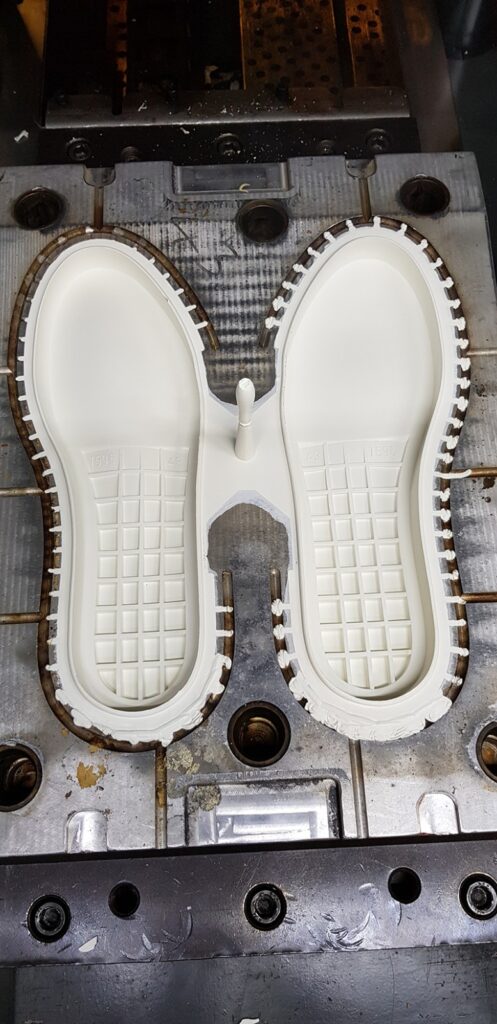
Once the design is finalized, CAD modeling and mold development begin. Digital foot scanning is often used to improve structural accuracy, especially for custom orthotic applications.
Mold production typically involves CNC machining to ensure dimensional precision. After the mold is completed, prototype insoles are produced for testing and validation.
At this stage, multiple prototypes may be created with different density levels or structural adjustments to evaluate performance differences under real conditions.
6. Testing and Performance Validation
Before mass production, prototypes undergo mechanical and biomechanical testing to ensure functional reliability.
Key testing areas include:
Biomechanical testing
- Plantar pressure distribution analysis
- Arch support effectiveness
- Gait stability evaluation
Material performance testing
- Compression resistance and rebound behavior
- Deformation recovery (compression set)
- Long-term fatigue performance
User evaluation
Real-world wear testing is often conducted to assess comfort consistency, pressure relief, and adaptability across different foot shapes.
7. Mass Production and Process Control
Once validated, the product enters mass production. At this stage, process stability becomes more important than design flexibility.
Raw materials are strictly controlled for density consistency and foam structure uniformity. In production practice, even small variations in foam expansion can lead to noticeable differences in cushioning behavior.
Typical manufacturing steps include:
- Foam molding and expansion
- Thermoforming or hot pressing
- Die cutting and shaping
- Surface finishing and trimming
For multi-layer insoles, additional lamination processes are used to bond different materials into a stable structure.
8. Quality Control and Production Consistency
Quality control is a key factor in orthotic insole manufacturing, especially for OEM and ODM production.
Inspection typically includes:
- Dimensional accuracy checks
- Hardness and density testing
- Visual inspection for defects
- Batch-to-batch consistency evaluation
In professional production systems, sampling inspections are often conducted under AQL standards. For performance-grade insoles, compression fatigue tests may also be used to simulate long-term wear conditions.
Maintaining consistency across batches is critical because even minor deviations can affect biomechanical performance in end-use applications.
9. OEM and ODM Customization Capability
One of the key advantages of modern orthotic insole manufacturing is customization. OEM and ODM systems allow brands to adjust product parameters based on market needs.
Customizable elements include:
- Material composition and formulation
- Density and hardness levels
- Arch support structure
- Thickness and multi-layer design
This flexibility enables manufacturers to serve different segments, including medical orthotics, sports performance insoles, and industrial footwear solutions.
10. Conclusion
Orthotic insole manufacturing is a structured engineering process that integrates biomechanics, material science, and industrial production control.
In most OEM projects, product success depends not only on design quality but also on how consistently that design can be reproduced at scale.
Material control, biomechanical accuracy, and manufacturing stability all play a critical role in determining final product performance.
Ultimately, a well-manufactured orthotic insole is the result of controlled engineering decisions at every stage—from concept development to mass production.
Related Post:
Comparison of Two Custom Orthotic Insole Manufacturing Processes