Material selection plays an important role in modern insole manufacturing. As footwear brands develop lighter and more streamlined products, manufacturers need cushioning materials that balance weight, rebound, flexibility, and structural stability.
Supercritical foam insoles offer an alternative to conventional foam-based constructions. Using nitrogen foaming technology, this material develops a microcellular structure designed to deliver lightweight cushioning and responsive rebound performance.
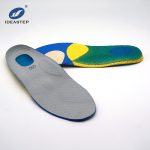
The IDEASTEP JF-425-1 combines a supercritical foam core with a sublimated microfiber velvet top cover, an integrated nylon support plate, and a PORON® cushioning pad. This multi-component construction provides a material solution for sports footwear, premium comfort footwear, and orthotic product development.

Understanding Supercritical Foam Technology
Supercritical foam technology uses a supercritical fluid, such as nitrogen, during the material foaming process. Under controlled temperature and pressure conditions, the gas forms small cells within the polymer matrix, creating a microcellular foam structure.
The resulting cell structure influences material density, weight, flexibility, compression behavior, and rebound characteristics. These properties make supercritical foam relevant to insole manufacturing, where material performance must align with thickness requirements and structural design.
Unlike conventional foam selection based primarily on softness or density, supercritical foam development also considers cell distribution and processing conditions. The final properties depend on the polymer formulation, foaming parameters, and subsequent manufacturing processes.
For insole manufacturers, evaluating the finished material’s physical properties is more important than relying on the foaming technology alone.
Material Performance in Supercritical Foam Insoles
The microcellular structure of supercritical foam provides several design advantages for lightweight insole production.
Lightweight Foam Construction
Material weight is an important consideration when developing slim-profile insoles. Supercritical foam offers a lightweight cushioning option that helps manufacturers control the overall weight of the insole without relying solely on thicker foam layers.
This characteristic is relevant to footwear designs with limited internal space, including performance footwear and streamlined casual shoe constructions.
Responsive Rebound Performance
Rebound describes the ability of a foam material to recover after compression. It is an important property when evaluating cushioning materials for footwear applications.
Supercritical foam can be formulated to provide a combination of softness and elastic recovery. Its suitability depends on the required cushioning response, foam density, hardness, and product construction.
Microcellular Structure and Material Properties
The distribution and size of cells within the foam influence its mechanical behavior. A controlled microcellular structure can contribute to material uniformity and predictable compression characteristics.
For production applications, manufacturers should assess density, hardness, rebound, and compression recovery against the specifications required for the finished insole.
Compression Recovery and Performance Consistency
Compression recovery is another important factor in foam material selection. It helps determine how the material responds to repeated loading and whether it maintains its intended physical properties.
For wholesale and OEM projects, relevant material testing and batch inspection help establish consistent product specifications across production runs.
JF-425-1 Supercritical Foam Insole: Material Structure
The IDEASTEP JF-425-1 features a four-component construction. Each material serves a different role within the overall insole design.
Sublimated Microfiber Velvet Top Cover
The top cover uses sublimated microfiber velvet, providing a refined surface finish for the finished insole.
This material contributes to the product’s surface appearance and supports the development of premium insole collections.
Supercritical Nitrogen Foamed Cushioning Core
The supercritical nitrogen foamed layer serves as the main cushioning component.
Its microcellular structure is designed to provide lightweight construction, softness, and responsive rebound. It also supports the development of thinner insole profiles where material thickness and weight are important design considerations.
Integrated Nylon Support Plate
An integrated nylon support plate provides additional structural stability within the insole.
It is designed to support the midfoot structure and limit excessive torsional movement. Combined with the foam core, the plate creates a construction that incorporates both cushioning and structural support components.
PORON® Shock Absorption Pad
The JF-425-1 incorporates a PORON® pad as an additional cushioning component.
Its localized placement complements the supercritical foam core by adding a separate shock-absorbing element. This multi-material arrangement allows different components to contribute distinct properties to the overall insole construction.
Key Design Features of the JF-425-1
The JF-425-1 combines lightweight foam technology with additional structural and cushioning components.
- Ultra-thin construction: Suitable for insole designs with limited available thickness.
- Supercritical foam core: Provides a lightweight cushioning structure with responsive rebound characteristics.
- Microfiber velvet top cover: Adds a refined surface finish.
- Nylon support plate: Provides additional midfoot structural stability.
- PORON® cushioning pad: Adds localized shock absorption.
- Multi-material construction: Combines surface, cushioning, and support components within one insole design.
Rather than relying on a single foam material, this construction uses multiple components to address different material and structural requirements.
Applications in Footwear and Orthotic Product Manufacturing
Supercritical foam technology can be considered in several footwear and insole manufacturing categories. Product specifications should be matched to the construction requirements of each application.
Sports Footwear Manufacturing
Sports footwear manufacturers often evaluate insole weight, rebound, cushioning structure, and torsional stability during product development.
The JF-425-1 combines a lightweight foam core with a nylon support plate and PORON® cushioning pad. This configuration provides an option for performance footwear projects requiring a slim, multi-component insole design.
Premium Comfort Footwear
Premium footwear collections may require lightweight materials, controlled thickness, and a refined surface finish.
The microfiber velvet cover and supercritical foam core provide a combination of surface and cushioning properties that can be considered in these product lines.
Orthotic Insole Manufacturing
Orthotic insole manufacturers can evaluate supercritical foam as an alternative cushioning material within specific product constructions.
The integrated nylon support plate adds a structural component, while the foam core provides the main cushioning layer. Final suitability depends on the required support geometry, material specifications, and intended insole design.
OEM and Private Label Production
For footwear brands and insole distributors, supercritical foam insoles can form part of a customized product range.
Logo printing and private label packaging support brand-specific product development. Material and structural requirements can be discussed during the sample evaluation and order confirmation stages.

Key Considerations When Sourcing Supercritical Foam Insoles
For B2B buyers, selecting a suitable insole supplier requires an evaluation of material specifications, construction consistency, customization capabilities, and production arrangements.
Material Specifications and Testing
Buyers should request available technical data covering:
- Foam density and hardness
- Rebound performance
- Compression recovery
- Overall insole weight
- Dimensional tolerances
These parameters provide a basis for comparing products and confirming whether the material meets the requirements of the target footwear category.
Thickness and Structural Configuration
Overall thickness, support plate placement, and cushioning pad positioning should be confirmed before production.
For slim-profile applications, dimensional accuracy is particularly important because the insole structure must correspond to the available space within the footwear design.
Production Consistency and Quality Control
Consistent material properties and dimensions are essential for repeat wholesale orders.
Buyers should review the supplier’s inspection procedures, production tolerances, material sourcing, and batch control arrangements. These factors help reduce specification variations between production runs.
OEM Customization and Branding
Private label projects may involve custom logo printing, packaging specifications, and other agreed product details.
Before confirming an order, buyers should establish the available customization options, artwork requirements, and production arrangements with the supplier.
Sample Evaluation and Order Planning
Sample evaluation allows buyers to inspect material quality, surface finish, flexibility, structural configuration, and dimensional accuracy before bulk production.
MOQ, pricing, lead time, and production capacity should also be confirmed according to the order quantity and customization requirements.
JF-425-1 Supercritical Foam Insoles from IDEASTEP
IDEASTEP develops and supplies insole products for footwear brands, orthotic product suppliers, and wholesale distributors.
The JF-425-1 Supercritical Foam Insole features a sublimated microfiber velvet top cover, a supercritical nitrogen foamed cushioning core, an integrated nylon support plate, and a PORON® cushioning pad. Its construction combines lightweight cushioning with additional structural support in a slim-profile design.
B2B cooperation options include:
- Custom logo printing
- Private label packaging
- Flexible MOQ options
- Wholesale pricing
- Samples for product evaluation
For footwear brands and distributors sourcing lightweight, high-rebound insole solutions, the JF-425-1 offers a multi-material construction for further product development.
Contact IDEASTEP to discuss your specifications, request samples, and obtain wholesale pricing.
Related insoles selling links: https://www.aideastep.com/product/jf-425-1-supercritical-foam-insoles/.