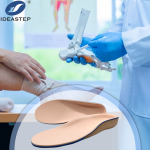
Custom sport orthotics combine structural support, cushioning, and flexibility for different athletic footwear applications. Their design depends on the sport, shoe construction, loading conditions, and required mechanical properties.
For sports footwear brands and orthotic manufacturers, the main challenge is balancing support and cushioning without adding unnecessary bulk or restricting the shoe’s intended flexibility. Material selection, shell geometry, and layer construction must be considered together.

1. Key Design Requirements for Sports Orthotics
Different sports place different demands on insole structures. Running, court sports, and general training may require different combinations of stiffness, cushioning, and flexibility.
Key design factors include:
- Stability: Shell geometry and reinforcement should maintain the specified structure under repeated loading.
- Cushioning: Foam materials must provide suitable compression behavior and recovery.
- Flexibility: Forefoot bending characteristics should match the footwear construction.
- Weight: Material selection and component thickness should limit unnecessary bulk.
- Footwear compatibility: Insole length, width, heel profile, and overall thickness must fit the target shoe.
These requirements provide the basis for material selection and structural development.
2. Materials for Stability and Cushioning
Sports orthotics often combine foam, thermoplastics, and composite materials. Each material contributes different mechanical properties.
EVA Foam
EVA is widely used in sports insoles because its density, hardness, and thickness can be adjusted for different cushioning and support requirements.
Different grades can be used in the heel, arch, and forefoot. Consistent material specifications help control compression and rebound characteristics across production batches.
Polyurethane (PU) and PORON
PU and PORON are commonly used in cushioning layers. Their density, thickness, and compression recovery determine their suitability for different insole sections.
They can be integrated into selected zones to achieve specific cushioning characteristics without increasing the thickness of the entire product.
Thermoplastic Polyurethane (TPU)
TPU is suitable for flexible structural components, including heel stabilizers and reinforcement elements. Its thickness and geometry influence flexibility and resistance to repeated deformation.
Polypropylene (PP)
PP is used for rigid or semi-rigid shells. It can be thermoformed into defined support structures, with shell thickness and geometry determining the final stiffness.
Carbon Fiber Composites
Carbon fiber composites provide a high stiffness-to-weight ratio. They can be used for lightweight reinforcement or components requiring controlled bending stiffness.
Fiber orientation, laminate thickness, and component geometry are key factors in determining their mechanical properties.
3. Structural Design for Stability
The shell and support geometry determine how the insole maintains its shape under load. Key structural features should be developed as part of one integrated design.
Arch Support Geometry
Arch height, length, curvature, and shell thickness affect the stiffness of the support section. CAD specifications should define these dimensions to maintain consistency across production batches.
Heel Cup and Rearfoot Structure
Heel cup depth, width, wall angle, and transition into the arch section determine the rearfoot geometry. The design must also account for the internal heel counter and available space in the target footwear.
Medial and Lateral Reinforcement
Flanges, posting, and reinforcement components can be added to selected areas to adjust structural stiffness. Their position and thickness should be controlled to avoid unnecessary material buildup.
Forefoot Flexibility
The forefoot structure must accommodate the bending characteristics of the shoe. Shell termination, material transitions, and edge profiles all influence flexibility.
A rigid shell may use a shorter extension or a separate flexible forefoot section, depending on the product specification.
4. Cushioning and Layer Construction
Layer construction allows manufacturers to combine structural support with different cushioning properties.
| Layer or Component | Common Material | Main Function |
|---|---|---|
| Top Cover | Fabric, microfiber, or mesh | Surface finish and wear resistance |
| Cushioning Layer | EVA, PU, or PORON | Compression and impact absorption |
| Structural Shell | PP or TPU | Shape retention and support |
| Reinforcement | TPU or carbon fiber composite | Localized stiffness control |
| Bottom Layer | EVA or other foam | Cushioning and footwear interface |
Full-Length Cushioning
A full-length foam layer provides consistent coverage across the insole. Density and thickness can be selected according to the required cushioning characteristics.
Zoned Cushioning
Different materials or foam densities can be assigned to the heel, arch, and forefoot. This allows manufacturers to adjust compression behavior by section.
Multi-Density Construction
Combining foam grades with different hardness or density values creates a varied cushioning profile. Layer thickness, bonding compatibility, and dimensional tolerances should be verified during development.
5. Manufacturing Processes
Manufacturing methods depend on material selection, shell geometry, and production volume.
Compression Molding
Compression molding is used for suitable foam materials and molded components. Temperature, pressure, and molding time affect the finished dimensions and material properties.
Thermoforming
Thermoforming is commonly used for PP and other suitable thermoplastics. Mold accuracy, heating conditions, and forming pressure influence shell geometry and dimensional consistency.
CNC Milling
CNC milling produces shell components from suitable blocks or blanks using CAD-based machining paths. It provides control over contours, thickness, and edge details.
Die Cutting and Lamination
Die cutting prepares foam and fabric layers to specified dimensions. Lamination joins the top cover, cushioning materials, and structural components.
Adhesive compatibility, surface preparation, and layer alignment are important for preventing bonding defects.
3D Printing
3D printing supports the production of complex support structures and customized geometries. Material selection, print orientation, wall thickness, and process settings must be validated before bulk production.

6. OEM/ODM Specifications for Sports Orthotics
Clear technical specifications help reduce sample revisions and maintain consistency during mass production.
| Specification | Details to Confirm |
|---|---|
| Intended Application | Running, training, court sports, or other activities |
| Insole Structure | Full-length, three-quarter length, or custom configuration |
| Cushioning Materials | EVA, PU, PORON, or multi-density foam |
| Structural Materials | PP, TPU, or carbon fiber composite |
| Arch Geometry | Height, length, curvature, and thickness |
| Heel Structure | Heel cup depth, width, and reinforcement |
| Forefoot Design | Flexibility, thickness, and extension length |
| Top Cover | Fabric, mesh, microfiber, or other material |
| Dimensions | Length, width, thickness, and size range |
| Production Volume | Sample quantity and expected bulk order |
CAD drawings, material specifications, and physical samples should be confirmed before production approval.
7. Quality Control and Performance Testing
Quality control should cover material properties, structural dimensions, mechanical performance, and assembly.
Key inspection points include:
- Material inspection: Verify foam density, hardness, thickness, and relevant technical specifications.
- Dimensional inspection: Check arch geometry, heel cup dimensions, overall thickness, and component positions.
- Compression testing: Evaluate compression behavior and recovery using agreed test methods.
- Flex fatigue testing: Assess structural durability under repeated bending.
- Bonding inspection: Check adhesion between foam layers, shells, and top covers.
- Finished product inspection: Check surface quality, edge finishing, alignment, and batch consistency.
Test methods and acceptance limits should be defined according to the material combination and product requirements.
Conclusion
Developing sports orthotics is a balance between structural control and freedom of movement. A rigid shell may improve support but can add weight or limit forefoot flexibility, while softer materials require careful consideration of compression and durability. The right combination depends on the footwear design and intended application.
For OEM/ODM projects, material samples, structural prototypes, and production testing should be evaluated together before specifications are finalized. Ideastep works with sports footwear brands and orthotic manufacturers on custom insole materials and component development, with bulk supply options available for approved projects.
Related Articles: What is Custom Sport Orthotics.