Carbon fiber composites are used in custom orthotic insole development when a design requires structural reinforcement with limited material thickness and weight. Unlike conventional foam or plastic components, carbon fiber laminates allow manufacturers to adjust stiffness through fiber orientation, layer configuration, and composite geometry.
This makes carbon fiber an interesting option for orthotic structures that require more precise control over bending behavior and support characteristics. However, the final properties depend on the entire composite design, not simply the choice of carbon fiber as a material.

1. How Carbon Fiber Changes Orthotic Structure Design
Traditional orthotic constructions often rely on EVA, polypropylene, or other polymer materials to form their supporting structures. Carbon fiber introduces a different design approach because its mechanical properties are closely related to the direction and arrangement of the reinforcing fibers.
A composite component can be designed with different stiffness characteristics along different directions. This allows manufacturers to consider structural requirements more precisely than when using a material with relatively uniform properties.
For custom insole development, the main design considerations include:
- Bending stiffness: Determines how much the component flexes under an applied load.
- Torsional stiffness: Influences resistance to twisting.
- Structural thickness: Affects the space required within the footwear construction.
- Weight distribution: Helps limit unnecessary material in the finished product.
- Geometric profile: Determines how the composite component fits into the overall insole shape.
These factors need to be considered together. Increasing stiffness, for example, may require changes to laminate thickness, fiber orientation, or component geometry.
2. Fiber Orientation and Laminate Architecture
The structural behavior of carbon fiber composites is largely determined by how the reinforcing fibers are arranged.
Unlike isotropic materials, carbon fiber laminates are anisotropic, meaning their mechanical properties vary with direction. This characteristic gives designers greater control over the response of a composite component.
Unidirectional Layup
Unidirectional carbon fiber layers concentrate reinforcement along a particular direction. They are useful when a design requires greater stiffness along a defined axis.
Woven Fabric Layup
Woven carbon fiber fabric contains fibers arranged in intersecting directions. It provides reinforcement across multiple directions and can be used in more complex composite constructions.
Multi-Angle Laminate Design
Combining layers with different fiber orientations creates a laminate with more balanced directional properties. The specific arrangement depends on the required bending and torsional characteristics.
For orthotic applications, fiber orientation should be established during the engineering stage. Changing the layup can alter the structural response even when the material type and overall thickness remain unchanged.
3. Designing Carbon Fiber Plates and Shells
The shape of a carbon fiber component is just as important as its material composition. A flat plate, contoured shell, and partial reinforcement structure will distribute loads differently.
Common design configurations include:
Full-Length Composite Plates
Full-length plates extend through most of the insole and provide a continuous reinforced structure. Their thickness, contour, and stiffness need to match the intended product design and available footwear space.
Partial-Length Reinforcement
Partial reinforcement places composite material in selected sections rather than across the entire insole. This reduces material coverage and allows different areas to have different structural characteristics.
Contoured Composite Shells
Contoured shells follow a defined three-dimensional profile. Their geometry can incorporate specific curves and transitions, making accurate tooling and forming important during development.
Localized Reinforcement
Smaller composite components can be incorporated into selected areas of an insole. Their dimensions and placement should be coordinated with the surrounding layers to avoid abrupt changes in thickness or stiffness.
The choice between these configurations depends on the product’s structural requirements, footwear compatibility, and overall construction.
4. Integrating Carbon Fiber with Cushioning Materials
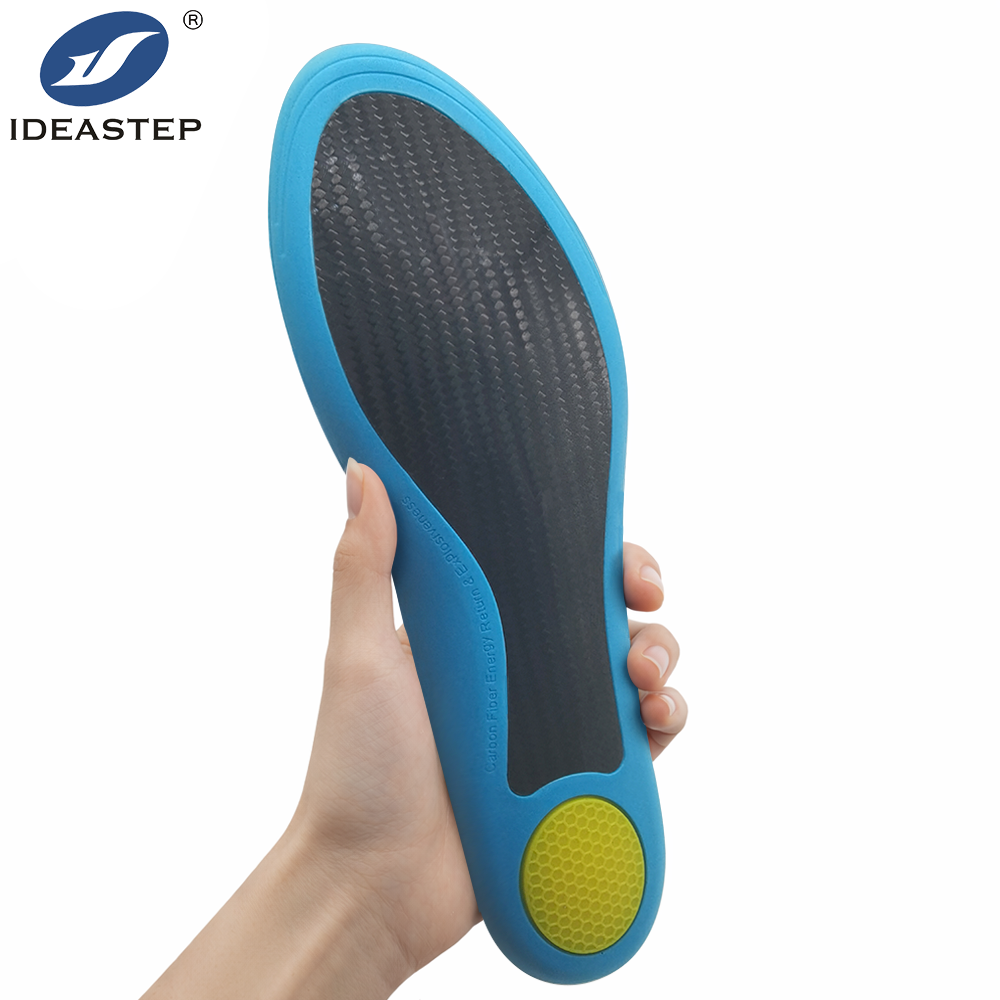
Carbon fiber composites are generally incorporated into multi-material constructions. The composite provides structural reinforcement, while other materials manage cushioning, surface contact, and layer transitions.
Typical material combinations include:
| Material | Function in Composite Insole Construction |
|---|---|
| Carbon Fiber Composite | Structural reinforcement and controlled stiffness |
| EVA Foam | Lightweight cushioning and intermediate support layers |
| PU Foam | Resilient cushioning and material transition |
| PORON | Localized cushioning |
| Microfiber or Fabric | Top cover and surface finishing |
| TPU | Flexible or semi-rigid supporting components, depending on grade |
The position of each layer affects the overall construction. A carbon fiber plate placed between two foam layers will behave differently from one positioned directly beneath the top cover.
Manufacturers should also consider the interface between materials. Differences in flexibility, surface energy, and thermal behavior can influence bonding and assembly. Adhesive selection and surface preparation should therefore be evaluated during prototype development.
5. From Composite Design to Finished Components
Carbon fiber processing requires methods suited to the selected reinforcement and resin system. The manufacturing route should be established before finalizing the component design.
Cutting and Material Preparation
Carbon fiber fabrics or prepreg sheets are cut according to the required dimensions. Material orientation must be maintained during preparation because incorrect placement can change the intended laminate properties.
Layup and Forming
Prepared layers are arranged in the specified sequence and placed into suitable tooling. For thermoset composites, forming is followed by a controlled curing process. Thermoplastic composites require processing conditions appropriate to their polymer matrix.
Trimming and Edge Finishing
After forming, the component is trimmed to its final profile. CNC machining may be used where dimensional accuracy or complex contours are required. Appropriate dust extraction and protective procedures are necessary when machining carbon fiber.
Insole Assembly
The finished composite component is combined with cushioning layers and top covers. Its position, edge profile, and bonding surface must match the approved construction.
6. Engineering Challenges in Carbon Fiber Orthotic Development
Although carbon fiber offers considerable design flexibility, it also introduces technical challenges that need to be addressed during development.
Balancing stiffness and flexibility
A laminate that is too rigid may not suit the intended design, while insufficient stiffness may fail to meet structural requirements. Fiber orientation, layer count, and component geometry should be adjusted together.
Managing edge transitions
Carbon fiber components can create noticeable changes in thickness and rigidity. Tapered edges and suitable surrounding foam layers can help create a more gradual transition within the insole construction.
Controlling laminate quality
Wrinkles, voids, fiber misalignment, and inconsistent resin distribution can affect composite integrity. Material preparation, layup, and curing procedures need to be controlled.
Ensuring material compatibility
Carbon fiber components must bond reliably with the selected foam, fabric, or polymer layers. Surface preparation and adhesive compatibility should be verified through prototype testing.
Maintaining repeatability
Changes in fiber orientation, laminate thickness, or forming conditions can affect the finished component. Approved construction specifications are essential when transferring a design from sampling to production.
7. Testing and Validation of Composite Structures
Carbon fiber orthotic components should be evaluated against their intended structural requirements. Testing should focus on the properties that matter to the specific design rather than applying a generic test list to every product.
Relevant evaluation methods may include:
- Bending stiffness testing: Measures resistance to bending under defined conditions.
- Torsional testing: Evaluates resistance to twisting.
- Flex fatigue testing: Examines structural changes after repeated loading.
- Dimensional inspection: Confirms thickness, contour, and component geometry.
- Bonding tests: Evaluates adhesion between composite and cushioning layers.
- Visual inspection: Identifies surface defects, exposed fibers, and forming irregularities.
Test methods and acceptance limits should be established during product development. The approved prototype can then serve as the reference for subsequent production.
8. Developing Carbon Fiber Orthotics for OEM and ODM Projects
Carbon fiber projects benefit from early technical coordination between the buyer and manufacturer. A clear design brief helps reduce unnecessary prototype revisions and ensures that the composite structure can be integrated into the complete insole.
Before sampling, buyers should provide or confirm:
- Intended footwear category and product application
- Composite component type and overall dimensions
- Required stiffness and bending characteristics
- Fiber type, orientation, and laminate thickness
- Three-dimensional contours or reference drawings
- Cushioning materials and layer arrangement
- Surface finish, logo, and packaging requirements
During sample evaluation, attention should be given to the complete construction, including the composite component, surrounding foam layers, edge transitions, and bonding quality.
Once the structure is approved, the specifications can be documented for repeat production and future size or design adjustments.
Conclusion
Carbon fiber expands the design possibilities for custom orthotic insoles by allowing manufacturers to control structural stiffness through fiber orientation, laminate architecture, and component geometry. Its value lies not only in reducing weight but also in creating carefully engineered composite structures.
Successful development depends on matching the laminate design to the intended application and integrating the composite with suitable cushioning materials and manufacturing processes.
Ideastep supports custom orthotic insole development through material selection, structural customization, sample evaluation, and OEM/ODM manufacturing. Contact our sales team to discuss your carbon fiber orthotic design and production requirements.
Related Reading: Carbon Fiber Orthotic Insoles: Structure, Flexibility and Custom Design.