In orthotic insole manufacturing, what truly defines product quality is not just the material itself, but the way it is engineered, processed, and consistently reproduced at scale. For B2B buyers such as footwear brands, medical distributors, podiatry clinics, and safety shoe manufacturers, understanding how an OEM orthotic insole factory operates is essential for choosing a reliable long-term partner.
This article provides a practical inside view of how professional orthotic insoles are developed and manufactured—covering OEM product development, material selection, production workflow, quality control systems, and the engineering logic behind consistent performance.
Why Manufacturing Quality Defines Orthotic Insole Performance
Orthotic insoles are biomechanical support products, not simple cushioning accessories. Their function directly affects foot alignment, pressure distribution, and long-term comfort during walking or standing. This means even small variations in density, arch geometry, or bonding strength can significantly change user experience.
Experienced manufacturers understand that consistency is more important than isolated sample quality. A well-performing prototype is not enough—what matters is whether the same performance can be reproduced across thousands of pairs in mass production.
This is why professional OEM orthotic insole production relies heavily on standardized engineering processes, controlled material parameters, and multi-stage quality verification.
Step 1: OEM Product Design & Engineering Development
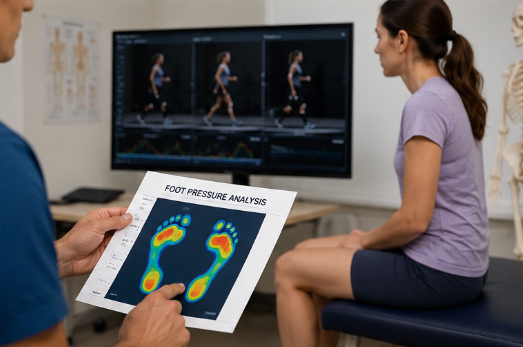
Every orthotic insole project begins with engineering consultation rather than simple product selection. At this stage, the goal is to translate market requirements into a manufacturable biomechanical structure.
Application & Biomechanical Requirement Analysis
Instead of only discussing target market or pricing, a professional OEM process also evaluates:
- Foot posture requirements (overpronation, flat feet, high arch, etc.)
- Pressure distribution goals
- Usage environment (work boots, sports, diabetic footwear, daily comfort)
- Expected lifespan and fatigue resistance
- Target retail positioning and material constraints
In some advanced projects, foot scan data or existing sample analysis is also used to optimize structure design.
Material Engineering Selection
Material selection is not just about comfort—it determines mechanical behavior under load.
Common materials include:
- EVA foam: available in multiple densities, balancing shock absorption and structural stability. Closed-cell EVA is widely used for long-term durability.
- PU foam: higher resilience and better long-term compression recovery compared to standard foams.
- TPU reinforcement shells: provide controlled rigidity for arch stabilization while maintaining flexibility in gait transition.
- Memory foam: used for pressure redistribution in comfort-oriented applications.
- Gel inserts: improve localized impact absorption, especially in heel strike zones.
- Ortholite®-type breathable foams: enhance moisture management and airflow for daily wear comfort.
In most OEM orthotic designs, multiple materials are combined in layered structures to balance cushioning, stability, and durability.
Prototype Engineering & Validation
Once the structure is defined, prototypes are produced using CNC cutting or mold-based forming systems. The goal is not only to verify appearance, but to evaluate biomechanical response under real conditions.
During this stage, adjustments are often made to arch height, heel cup depth, or material stacking to achieve the desired performance balance before mass production approval.
Step 2: Incoming Material Quality Control
In orthotic insole manufacturing, material variation is one of the most common causes of inconsistent performance. Therefore, raw material inspection is treated as a critical control point rather than a routine procedure.
Each batch of incoming materials is evaluated based on physical and mechanical properties such as density stability, hardness deviation, compression recovery rate, and bonding compatibility.
From a manufacturing perspective, even a slight deviation in foam density can affect arch support behavior and long-term deformation resistance. Materials that do not meet specifications are isolated before entering production to prevent downstream quality issues.
Step 3: Precision Orthotic Insole Manufacturing Process
Precision Cutting & Component Preparation
EVA sheets and composite materials are processed using CNC cutting systems or high-precision die-cutting tools. This ensures dimensional accuracy and consistent alignment between layers, which is critical for maintaining symmetrical support between left and right insoles.
Heat Molding & Structural Formation
Heat molding is one of the most important stages in orthotic insole production. Under controlled temperature, pressure, and timing conditions, the material is shaped into a three-dimensional structure that defines arch support, heel cup depth, and forefoot transition.
Even small variations in molding parameters can affect biomechanical performance, which is why industrial-grade process control is essential for consistency.
Lamination & Multi-Layer Bonding
Orthotic insoles often consist of multiple functional layers, including cushioning foam, support structures, surface fabrics, and anti-slip bottom layers.
Different adhesive systems are selected depending on material compatibility and product application. For example, sports insoles require higher bonding strength to withstand repeated impact cycles, while comfort insoles prioritize flexibility and softness.
Finishing, Edge Refinement & Surface Treatment
After assembly, each insole undergoes trimming, grinding, and surface refinement to remove excess material and ensure ergonomic edge smoothness. This step directly impacts wearing comfort and product aesthetics.
OEM Branding & Private Label Customization
OEM manufacturing also supports full brand customization, including logo printing, color matching, packaging design, instruction manuals, and retail-ready private label solutions. These services allow brands to build consistent product identity while relying on standardized manufacturing systems.
Step 4: Integrated Quality Control System
Unlike basic inspection models that rely only on final checks, professional orthotic insole factories implement quality control throughout the entire production chain.
In-Process Monitoring
During production, key parameters such as thickness consistency, weight variation, symmetry, and surface uniformity are continuously monitored. This allows early detection of deviations before they affect large production batches.
Functional Performance Testing
Finished products undergo mechanical and functional testing, including compression resistance, flex fatigue cycles, bonding strength verification, and arch support stability evaluation.
These tests simulate real-world usage conditions to ensure that the product maintains structural integrity over time.
Final Batch Inspection
Before packaging and shipment, final inspections verify appearance quality, labeling accuracy, packaging integrity, and quantity consistency. Only fully compliant batches are released for delivery.
Manufacturing Consistency Across Large-Scale Production
One of the biggest challenges in OEM orthotic insole production is maintaining consistency across thousands of units. This requires strict process standardization, calibrated machinery, controlled environmental conditions, and detailed batch traceability systems.
Consistency is not achieved by inspection alone—it is built into the production system itself through engineering discipline and process control.
Why Global Brands Work With Professional Orthotic Insole Factories
For international brands, selecting an OEM partner is not only about price competitiveness. More importantly, it involves engineering capability, production stability, customization flexibility, and long-term reliability.
Factories with strong technical backgrounds can support faster prototyping, better material recommendations, and more stable mass production outcomes. This reduces time-to-market while improving end-user satisfaction.
With decades of experience in orthotic insole manufacturing, Ideastep provides OEM/ODM solutions covering material development, structural design, prototyping, and scalable production for global customers.

Conclusion
Behind every reliable orthotic insole is a carefully controlled manufacturing system that integrates engineering design, material science, precision production, and multi-stage quality control. Understanding this process helps B2B buyers make more informed decisions when selecting OEM partners.
Whether you are developing a new orthotic product line or optimizing an existing design, working with an experienced manufacturer ensures better consistency, faster development cycles, and more stable market performance.
For OEM inquiries, technical consultation, or sample development, professional orthotic insole manufacturing support is available to help bring your product ideas into scalable production.