Podiatry clinics, footwear brands and footcare distributors require orthotic base components that balance clinical performance, shape retention and production consistency. TPU orthotic shells are widely adopted semi-rigid substrates for custom foot orthoses. Distinct from polypropylene, EVA and carbon fibre alternatives, their mechanical properties can be calibrated to match specific gait patterns and clinical use cases. Our engineering team collaborates closely with podiatric prescribers to tune shell stiffness, wall geometry and production workflows. This overview covers material fundamentals, design principles and OEM manufacturing considerations for professional sourcing.
Core Material Properties of Orthotic-Grade TPU
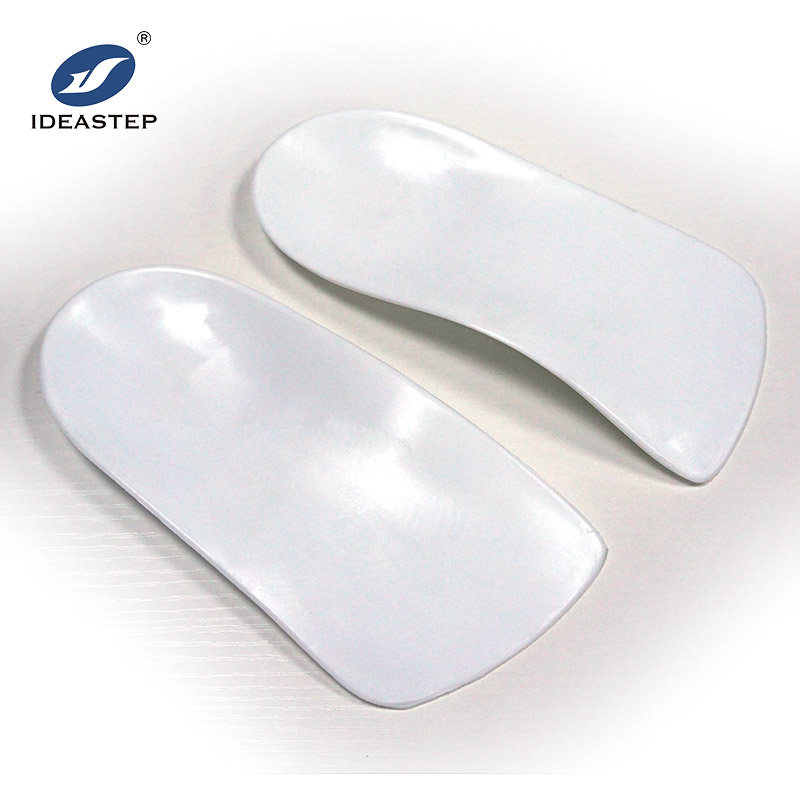
Thermoplastic polyurethane is a segmented block copolymer whose alternating hard and soft segments deliver controlled rigidity. It stabilises medial arch alignment to mitigate overpronation while flexing naturally through the gait cycle, avoiding the restrictive feel common with fully rigid substrates. This dynamic performance makes it suitable for sports orthotics and high-activity applications.
Shore hardness serves as the primary specification variable. Our orthotic TPU portfolio spans 70A to 95A. Lower hardness grades suit paediatric orthoses and mild correction, while 90A–95A formulations are specified for plantar fasciitis, moderate flatfoot and athletic orthoses requiring sustained arch support. The material exhibits low compression set under cyclic loading, resisting permanent deformation after repeated weight-bearing cycles. It also delivers reliable tear strength, abrasion resistance and stable performance across typical operational temperature ranges.
Medical-grade TPU for orthotic shells complies with ISO 10993 biocompatibility standards, presenting minimal irritation risk and compatible lamination with foam top covers. A key design consideration: extended exposure to high heat and persistent moisture accelerates material fatigue, so shell geometry and surface finishing must align with end-use environments.
Structural Design Principles for TPU Orthotic Shells
Functional TPU orthotic shells rely on targeted reinforcement and engineered flexible zones, developed against clinical prescription parameters. A deep, contoured heel cup anchors the calcaneus and limits excessive rearfoot motion. Heel cup wall thickness, flare angle and rim radius directly impact corrective performance; sharp edges introduce pressure points, while insufficient wall thickness compromises stiffness.
Variable-thickness midfoot architecture is standard for our clinical partners. Sections along the medial arch are reinforced for support, tapering laterally and through the forefoot to accommodate natural metatarsal expansion under load. Finite element stress analysis removes redundant material in flexible zones and adds local ribbing at high-load points. Perforated lattice structures can be integrated for ventilation and weight reduction, with porosity validated to avoid structural weakness under peak loading.
TPU shells support integrated posting geometry, reducing delamination risks associated with externally bonded wedges. Cut profiles are engineered to fit standard shoe lasts, with tapered forefoot forms compatible with running footwear, casual shoes and work boots. All design iterations receive gait-lab validation from clinical partners before bulk production. Compared to polypropylene, TPU provides superior flex recovery, whereas PP offers higher inherent stiffness at equivalent thickness and lower cost for high-volume basic orthoses.
Custom OEM Manufacturing for TPU Orthotic Shells
Our custom workflow begins with prescription datasets rather than generic moulds. Inputs include scan files, plaster casts or formal prescription documentation defining stiffness, heel depth, posting angle and target user groups. Our CAD team reconstructs shell geometry, runs FEA stress verification and delivers physical prototypes for clinical fit validation prior to tooling or batch release. Prototype assessment is mandatory for clinic clients to confirm in-shoe fit.
Two primary production routes are available. Vacuum thermoforming from orthotic-grade TPU sheet delivers cost-effective, consistent output for bulk semi-custom shell orders. 3D printed TPU shells support low-volume, highly customised runs, including post-surgical and paediatric orthoses and small private-label lines. Secondary operations include edge finishing, surface texturing, tinting and pre-cutting ready for foam lamination.
In-line quality control covers hardness testing, flex-fatigue sampling, dimensional cross-checking against approved STL files and visual inspection for voids, thin sections and sharp edges. Full test documentation accompanies shipments to support clinic audits and certification requirements. We supply bare TPU shells or complete finished orthoses with custom top covers, branding and packaging, per project requirements.
Specification Guidance For Your Product Line
For general adult orthoses targeting plantar fasciitis and mild overpronation, 85A–90A semi-rigid TPU with a deep heel cup serves as a versatile baseline. Athletic and running orthoses use 90A–95A material with reinforced arch sections and streamlined forefoot profiles to preserve propulsion. Paediatric applications typically specify 70A–80A TPU and softened heel geometry to support developing feet without over-restriction.
Shell thickness must align with footwear compatibility. Thicker shells deliver stronger correction but may not fit slim-profile footwear. We assist distributors in building tiered portfolios: clinical corrective shells for podiatry prescriptions and lighter support shells for retail footcare ranges.
Frequently Asked Questions
Will TPU orthotic shells crack under heavy use?
Properly formulated orthotic TPU is engineered for repeated flex recovery. Cracking is tied to incorrect hardness selection, insufficient wall thickness or sustained high-heat exposure. Correctly specified and designed TPU shells outperform many rigid alternatives in active-use scenarios.
Can podiatrists re-mould TPU shells on-site?
Thermoformed TPU sheet shells are heat-adjustable for in-clinic fine-tuning of heel cup and arch contour. 3D printed TPU shells are not designed for repeated re-moulding, an important distinction for clinical customers.
What is the MOQ for custom TPU orthotic shell OEM?
MOQ varies by production method. Thermoformed tooling supports large bulk runs, while 3D printing accommodates small clinic batches and prototype development. Flexible terms are available for distributors launching new orthotic lines.
Initiate Your TPU Orthotic Shell OEM Project
We work with podiatry clinics and footwear brands to preserve clinical performance without concessions to quality. Our team addresses both podiatric prescription requirements and manufacturing constraints. We avoid one-size-fits-all shell solutions; each project evaluates target patient profiles, footwear compatibility and documentation needs before locking material grade and design.
If you are developing an orthotic product line or switching shell suppliers, share your design brief, clinical priorities and order schedule. We provide material datasheets, fatigue test records and prototype timelines to define a stable, performance-focused shell specification for your footcare products.
Related Articles: Heat-Moldable TPU Orthotic Shells with Adjustable Rigidity and Ultra-Thin Heel.