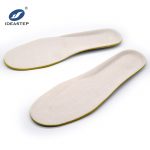
Molded arch supports are shaped structural components used in orthotic insoles and supportive footwear products. Their performance depends on material properties, arch geometry, shell thickness, and manufacturing accuracy.
For orthotic product manufacturers, wholesalers, and footwear brands, these factors determine product specifications, production methods, and compatibility with different insole constructions.
This guide covers the main technical considerations in molded arch support development, from material selection and structural design to molding processes and quality inspection.

1. Understanding Molded Arch Supports
Molded arch supports provide a defined supporting profile within an insole or footwear insert. Unlike flat foam layers, they feature a formed contour designed according to specific dimensional and structural requirements.
Depending on the product construction, they can function as independent components or form part of a multi-layer orthotic insole.
Common applications include:
- Custom and semi-custom orthotic insoles
- Sports and athletic footwear inserts
- Work footwear insoles
- Rehabilitation and foot-care products
- Specialized footwear components
Construction varies according to the intended application. Some designs use rigid or semi-rigid shells, while others combine molded foam with additional cushioning layers.
2. Key Design Features of Molded Arch Supports
Arch support design involves several interconnected parameters. Arch height, longitudinal contour, shell dimensions, and heel cup geometry must work together within the available footwear space.
Arch Height and Contour
Arch height defines the vertical profile of the supporting structure. Manufacturers can develop low-, medium-, and high-profile designs based on technical drawings, reference samples, or supplied measurements.
However, height alone does not define the arch structure. Width, longitudinal curvature, contact area, and transition geometry also affect the finished profile.
Shell Length and Coverage
Molded arch supports vary in length and coverage. Some extend from the heel toward the midfoot, while others incorporate a larger rearfoot structure.
The selected configuration depends on the insole design, required support area, and available footwear volume. Manufacturers should confirm these dimensions before tooling.
Shell Thickness and Rigidity
Shell thickness and material stiffness determine the structural characteristics of the finished component.
A thicker shell does not necessarily provide a more suitable structure. Material grade, geometry, and forming conditions must also be considered when defining rigidity and flexibility.
Heel Cup Integration
Some designs combine the arch support with a heel cup to create an integrated rearfoot structure.
Important dimensions include heel cup depth, width, wall thickness, and the transition into the arch section. These features should match the overall shell geometry and intended footwear construction.
Edge Design and Component Integration
Edge thickness, curvature, and surface condition affect how the support connects with surrounding insole materials.
For multi-layer constructions, manufacturers should consider bonding surfaces, component alignment, and total assembly thickness. Poorly designed transitions can create uneven surfaces or assembly difficulties.
3. Materials Used in Molded Arch Supports
Material selection depends on the required rigidity, flexibility, thickness, forming method, and compatibility with other insole components.
Polypropylene (PP)
PP is widely used in rigid and semi-rigid orthotic shells. Its stiffness and thermoformability make it suitable for components with defined arch and heel cup profiles.
Material thickness and shell geometry influence the finished structure. Manufacturers should also account for heating, forming, and cooling conditions during production.
Thermoplastic Polyurethane (TPU)
TPU is available in different hardness grades and offers adjustable flexibility and mechanical properties.
Depending on its formulation and processing method, TPU can be used in molded arch components or integrated supporting structures. Material selection should reflect the required stiffness, elasticity, and forming conditions.
EVA
EVA is widely used in insole manufacturing because of its low weight, flexibility, and adjustable density and hardness.
Molded EVA components can provide cushioning or structural support, depending on their formulation and geometry. Different density grades also allow manufacturers to develop multi-density constructions.
Polyurethane (PU)
PU materials cover a range of formulations with different mechanical properties. Flexible PU foam is commonly used in cushioning components, while other polyurethane systems may serve different structural purposes.
Manufacturers should specify the formulation and evaluate its compression behavior, resilience, and processing requirements before production.
Material Comparison
| Material | Main Characteristics | Manufacturing Considerations |
|---|---|---|
| PP | Rigid and semi-rigid grades; suitable for defined shell profiles | Thermoforming and controlled cooling |
| TPU | Adjustable hardness and flexibility | Material-specific molding parameters |
| EVA | Lightweight; adjustable density and hardness | Suitable molding processes depend on formulation |
| PU | Properties vary by formulation | Processing conditions depend on the material system |
No single material suits every molded arch support. The selection should match the required structure, production volume, cost target, and insole assembly.
4. Manufacturing Methods for Molded Arch Supports
The manufacturing method depends on material characteristics, component geometry, order volume, and dimensional requirements. Different designs may require different forming and finishing processes.
Thermoforming
Thermoforming is commonly used for thermoplastic sheets such as PP.
The sheet is heated to the required forming temperature and shaped over a mold using controlled pressure or vacuum. After cooling, the component retains the specified profile.
Key process parameters include:
- Heating temperature and duration
- Forming pressure or vacuum
- Mold geometry
- Material thickness
- Cooling conditions
Consistent heating and mold positioning help control the final dimensions and shell profile.
Compression Molding
Compression molding uses heat and pressure to form suitable materials inside a mold cavity. It is commonly used for selected EVA and other moldable insole components.
Material loading, mold temperature, pressure, and molding time affect component thickness, density, surface finish, and dimensional consistency.
Mold design should account for material flow, shrinkage, and the required final geometry.
Injection Molding
Injection molding is suitable for compatible thermoplastic materials and components requiring repeatable geometry at production scale.
Molten material enters a closed mold cavity under controlled pressure. After cooling and solidification, the component is removed.
Important parameters include material preparation, melt temperature, injection pressure, mold temperature, cooling time, and gate design. Tooling cost and expected order volume should also be considered when selecting this process.
CNC Processing
CNC milling produces support profiles from suitable foam blocks and other machinable materials using CAD data.
It allows control over arch contours, thickness, and surface geometry. This process is particularly useful for customized components, sample development, and designs requiring specific dimensional profiles.
Machining accuracy depends on the design file, material stability, machine setup, and cutting parameters.
Trimming and Finishing
Formed components may require trimming, edge finishing, drilling, or surface preparation before assembly.
These operations remove excess material and prepare bonding surfaces. Manufacturers should control trimming dimensions and inspect edges for defects that could affect assembly or product appearance.
5. Customization Options for Molded Arch Supports
B2B projects often require variations in material, geometry, dimensions, and branding. The customization scope should be confirmed before tooling and sample development.
Common options include:
- Arch profile: Height, width, contour, and transition geometry.
- Shell dimensions: Length, width, thickness, and coverage.
- Material: PP, TPU, EVA, or suitable PU formulations.
- Rigidity: Defined according to material grade and structural requirements.
- Heel cup: Depth, width, and wall profile.
- Surface finish: Texture, color, and edge treatment.
- Insole integration: Compatibility with foam layers, top covers, and other components.
- Branding: Logo application, product identification, and customized packaging.
For OEM and ODM projects, buyers should provide technical drawings, reference samples, or dimensional specifications. These details help manufacturers assess tooling requirements and production feasibility.

6. Quality Control in Molded Arch Support Production
Quality inspection should cover incoming materials, forming operations, and finished components. Criteria should correspond to the approved design and material specifications.
Incoming Material Inspection
Key checks include:
- Material type and grade
- Thickness and dimensional consistency
- Density and hardness where applicable
- Surface condition and color
- Batch identification and supplier documentation
Material variations can affect forming behavior and finished component properties. Incoming inspection helps identify inconsistencies before processing.
In-Process Inspection
Production checks should focus on parameters that influence the final structure.
Depending on the process, these may include heating temperature, molding pressure, cycle time, cooling conditions, material loading, and trimming dimensions.
Manufacturers should also monitor mold condition and equipment settings to control variation between batches.
Finished Component Inspection
Finished molded arch supports should be checked against the approved sample and technical specifications.
Typical inspection points include:
- Arch height and contour
- Length, width, and thickness
- Heel cup dimensions, where applicable
- Surface appearance and edge quality
- Warping or deformation
- Structural consistency
- Compatibility with the intended insole construction
For assembled products, inspection should also cover bonding strength, component positioning, and overall thickness.
7. Mold Design and Production Considerations
Mold design affects component geometry, production efficiency, and tooling costs. Before tooling begins, manufacturers should review the technical drawing, material characteristics, production method, and dimensional tolerances.
Mold Geometry
The mold must reproduce the specified arch contour, heel cup profile, shell thickness, and edge transitions.
Designers should also account for material shrinkage and forming behavior. These factors may require dimensional adjustments during tooling development.
Tooling Material and Construction
Tooling material depends on the forming process, production volume, component geometry, and required service life.
The mold should maintain stable processing conditions and allow practical maintenance.
Production Volume and Tooling Cost
Tooling investment should reflect the expected order quantity and repeat production requirements.
For new designs, sample development can verify the geometry before full production tooling. Buyers should also clarify tooling ownership, maintenance responsibilities, and modification costs in OEM/ODM agreements.
8. Evaluating a Molded Arch Support Manufacturer
Supplier evaluation should focus on technical capability, process control, and production capacity.
Material expertise: Check experience with PP, TPU, EVA, and other materials required by the project.
Molding capabilities: Confirm access to the necessary thermoforming, compression molding, injection molding, or CNC processing equipment.
Design and tooling support: Assess the ability to interpret technical drawings, develop molds, and refine component geometry.
Quality management: Review incoming material inspection, process monitoring, dimensional checks, and finished product inspection.
Customization services: Confirm support for OEM/ODM development, size variations, material options, and private-label requirements.
Production capacity: Clarify MOQ, sample lead time, bulk production schedules, and capacity for repeat orders.
A manufacturer with relevant processing experience can identify material and tooling issues during development, reducing unnecessary adjustments before mass production.
9. Preparing Molded Arch Supports for Bulk Production
Before mass production, buyers and manufacturers should confirm the technical and commercial requirements:
- Material grade, thickness, and hardness.
- Arch geometry, shell dimensions, and heel cup specifications.
- Manufacturing method and tooling requirements.
- Critical dimensions and inspection tolerances.
- Sample approval criteria.
- MOQ, production lead time, and packaging requirements.
The approved sample, drawings, and inspection criteria should serve as production references for repeat orders. Changes to material grades, mold geometry, or processing conditions should be reviewed and approved before implementation.
Molded Arch Support Manufacturing with Ideastep
Ideastep supports B2B orthotic insole projects through material selection, structural customization, OEM/ODM development, and bulk manufacturing. Our product range includes supportive shells, EVA foam components, cushioning layers, and customized top covers.
For molded arch support projects, buyers can discuss material requirements, arch profiles, dimensions, production methods, and order quantities with our team.
Contact Our Team
Contact our team to discuss your molded arch support requirements.