EVA (ethylene-vinyl acetate) plays a central role in modern custom orthotic insole manufacturing. In real production environments, it is not chosen simply for comfort. It is selected because it allows manufacturers to control structure, density, and long-term mechanical behavior in a consistent way across large-scale OEM production.
For orthotic brands, medical insole suppliers, and footwear manufacturers, EVA is often the material that balances three key requirements at the same time: cushioning performance, structural stability, and production repeatability.
This article explains how EVA material improves custom orthotic insole performance from a practical engineering and manufacturing perspective, rather than a purely theoretical one.
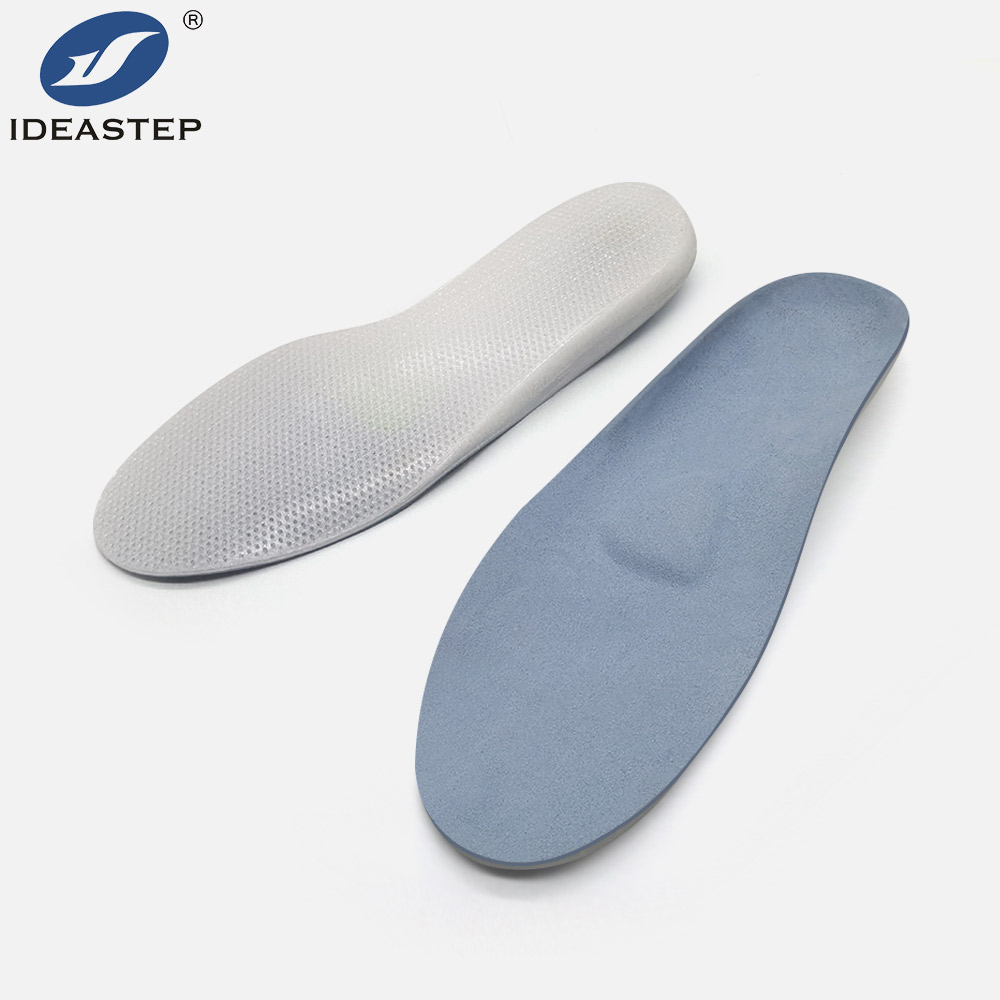
Why EVA Is Widely Used in Custom Orthotic Insoles
EVA is a closed-cell foam material formed through a controlled foaming process. Its internal structure is made up of uniform air cells that directly influence shock absorption, rebound speed, and long-term deformation resistance.
In production practice, EVA is widely used because it is one of the few materials that allows predictable adjustment of:
- Density levels
- Hardness range
- Compression behavior
- Rebound characteristics
Unlike many soft foams that vary significantly between batches, EVA can maintain relatively stable mechanical performance when production parameters are well controlled.
This stability is especially important for OEM and ODM projects, where thousands of pairs must perform consistently in real-world use.
EVA Foam Structure and Its Impact on Performance
The performance of EVA insoles is largely determined during the foaming and molding stage, where the internal closed-cell structure is formed.
Two technical factors are particularly important:
- Foam expansion ratio
- Cell size uniformity and distribution
A well-controlled foaming process produces a stable closed-cell structure. This structure helps maintain compression resistance, improves moisture resistance, and supports long-term dimensional stability.
In contrast, inconsistent foaming can lead to uneven density distribution. In real applications, this often shows up as:
- Localized collapse in high-pressure zones (heel or forefoot)
- Reduced cushioning consistency over time
- Faster fatigue breakdown under repetitive load
For orthotic insoles, structural consistency is not a secondary requirement—it directly determines product lifespan and user experience.
EVA Density and Its Role in Orthotic Performance
Among all material parameters, EVA density is the most critical factor in determining insole behavior.
Density influences how the material reacts under load, including softness, support strength, and long-cycle durability.
Low-density EVA
Low-density EVA is highly compressible and provides an immediate soft feel. It is typically used in comfort layers where cushioning is the priority. However, under long-term load, it tends to lose structure faster.
Medium-density EVA
Medium-density EVA is the most commonly used option in custom orthotic insoles. It provides a balanced performance profile, offering both cushioning and structural support under daily walking and standing conditions.
In most OEM applications, this density range is used as the structural base material.
High-density EVA
High-density EVA is used when structural control is more important than softness. It offers higher resistance to deformation and is commonly applied in corrective orthotic insoles and industrial footwear where long-term stability is required.
In real production, maintaining density consistency across batches is just as important as selecting the correct density level. Even small variations can lead to noticeable differences in support behavior, especially in medical or performance-oriented insoles.
How EVA Improves Comfort in Real Use Conditions
Comfort in orthotic insoles should not be defined only by softness. It is better understood as how effectively the material manages pressure distribution and impact forces during the gait cycle.
EVA contributes to comfort in three functional ways:
1. Impact absorption during heel strike
When the heel contacts the ground, EVA compresses to reduce peak impact force transmitted to the lower limb. This helps reduce stress on joints and soft tissue.
2. Controlled rebound during transition
After compression, EVA returns to its original shape at a controlled speed. This supports smoother gait transition from heel strike to toe-off, reducing muscular fatigue during long-term walking or standing.
3. Pressure redistribution across the footbed
EVA spreads load across a wider surface area instead of concentrating pressure at specific points such as the heel or forefoot. This helps reduce localized discomfort during extended wear.
When combined with proper orthotic geometry such as arch support and heel cup structure, EVA becomes part of a functional load management system rather than just a cushioning layer.
Performance Characteristics: Durability and Compression Stability
From an engineering perspective, EVA is evaluated based on how it performs after repeated loading cycles rather than its initial softness.
Compression set resistance
High-quality EVA maintains its original shape after repeated compression cycles. Low-quality materials tend to develop permanent deformation, which reduces support efficiency over time.
Fatigue resistance under long-term load
In applications such as work footwear or daily-use orthotics, insoles are exposed to continuous static and dynamic stress. Properly formulated EVA maintains predictable mechanical behavior even after extended use periods.
Structural stability
Unlike soft foams that collapse or lose rebound performance quickly, engineered EVA retains its internal cell structure, ensuring stable performance throughout the product lifecycle.
These characteristics are particularly important in industrial and medical applications where consistency is more valuable than initial softness.
EVA Compared to Other Insole Materials
In orthotic insole design, EVA is often compared with PU foam, gel, and memory foam. Each material serves a different functional purpose.
PU foam generally provides a softer long-term feel but tends to be heavier and less stable under high-load conditions. Gel materials offer strong shock absorption but lack structural support and rebound control. Memory foam adapts well to foot shape but responds slowly, making it less suitable for dynamic movement such as running or fast walking.
EVA occupies a middle position between these materials. It is not designed to be the softest or the most adaptive. Instead, it provides a balanced and controllable performance profile that can be adjusted through formulation and density control.
This balance is one of the main reasons EVA remains the dominant material in large-scale orthotic insole production.
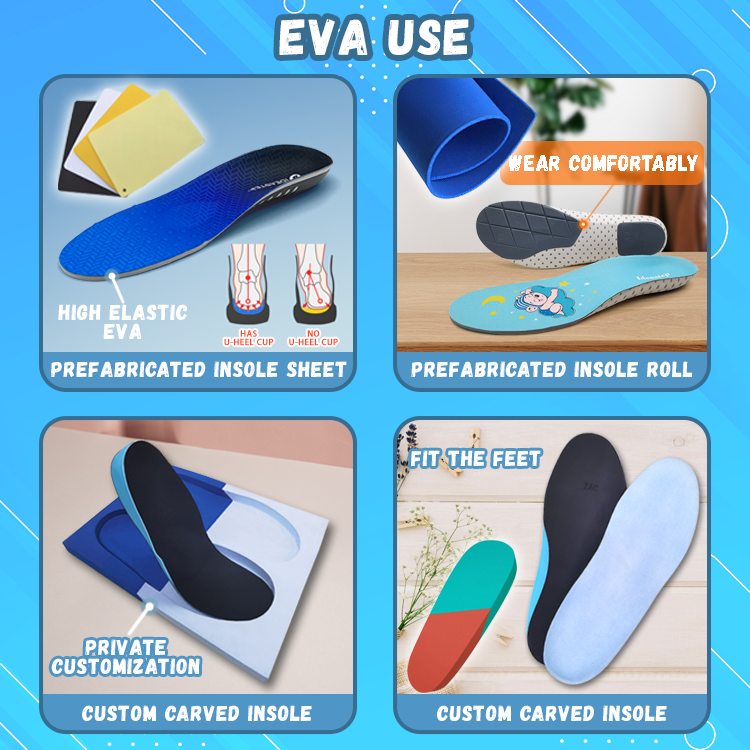
EVA in Custom Orthotic Insole Manufacturing Applications
EVA is widely used across different orthotic and footwear categories due to its flexibility in engineering and processing.
In medical orthotic insoles, EVA is used to support foot alignment and redistribute plantar pressure across the footbed. It is often combined with structured arch components for corrective functions.
In sports insoles, EVA provides impact absorption and rebound support during high-intensity movement, helping reduce stress during running or training.
In work and safety footwear, EVA helps reduce fatigue caused by long hours of standing or walking on hard surfaces, improving long-term comfort.
In OEM and ODM custom insole production, EVA allows manufacturers to adjust density, hardness, and multi-layer structures based on customer requirements. This makes it one of the most adaptable materials in the footwear industry.
Choosing EVA for OEM Production and Supplier Evaluation
For footwear brands and distributors, EVA selection is not only a material decision but also a manufacturing capability decision.
Key evaluation factors include:
- Density stability across production batches
- Closed-cell foam uniformity
- Compression performance consistency over time
- Ability to customize formulation for different applications
In practice, OEM buyers often prioritize production consistency over theoretical material performance. Small variations in foaming control or density distribution can directly affect end-user experience, especially in orthopedic or high-volume retail products.
A capable supplier should be able to adjust EVA formulation based on application needs rather than offering a fixed specification. This flexibility is critical in supporting different market segments.
Conclusion
EVA material plays a fundamental role in improving custom orthotic insole performance. Its real value lies in its engineering flexibility—especially the ability to control density, structure, and long-term mechanical stability.
By adjusting formulation and foaming conditions, manufacturers can design insoles that meet different functional needs, from soft comfort layers to high-support orthopedic structures.
For OEM and B2B footwear brands, understanding EVA is not only a material selection decision, but also a key factor in product consistency, user experience, and long-term market competitiveness.
Related Post: